


Published TCIMAIL newest issue No.201
Maximum quantity allowed is 999
Bitte wählen Sie die Menge aus.
CAS RN: 3375-31-3 | Produkte #: A1424
Palladium(II) Acetate

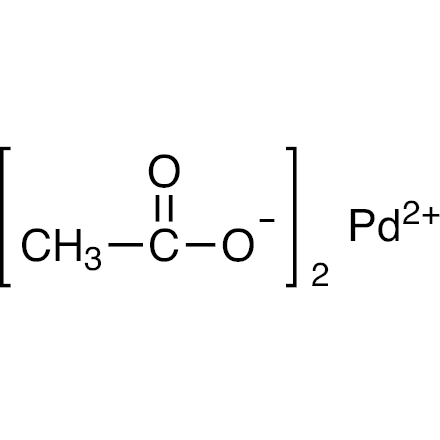
×

Reinheit: >98.0%(T)
Synonyme
- Acetic Acid Palladium(II) Salt
Produktdokumente:
| Einheit | Stückpreis | Belgien | Japan* | Menge |
Versandinformationen

|
|---|---|---|---|---|---|
| 1G |
€214.00
|
7 | ≥80 |
|
|
| 5G |
€1,027.00
|
Kontaktieren Sie uns | 29 |
|
*Lagerbestand in Belgien: Versand am selben Tag
*Lagerbestand in Japan: Bitte prüfen Sie die Versandsimulation für voraussichtliche Lieferzeiten. (ausgenommen regulierte Produkte und Trockeneissendungen)


| Artikel # | A1424 |
Reinheit / Analysenmethode 
|
>98.0%(T) |
| Summenformel / Molekülmasse | C__4H__6O__4Pd = 224.51 |
| Physikalischer Zustand (20 °C) | Solid |
| Lagerungstemperatur
|
Room Temperature (Recommended in a cool and dark place, <15°C) |
| Verpackung und Behälter
|
1G-Glass Bottle with Plastic Insert (Bild ansehen) |
| CAS RN | 3375-31-3 |
| Reaxys Registrierungsnummer | 3602276 |
| PubChem-Stoff-ID | 87562878 |
| Spektrale Daten (AIST) Link | 12841 |
| Merck-Index (14) | 6991 |
| MDL-Nummer | MFCD00012453 |
Spezifikation
| Appearance | Orange to Brown powder to crystal |
| Purity(Chelometric Titration) | 98.0 to 102.0 % |
| Elemental analysis(Nitrogen) | max. 3.0 % |
| NMR | confirm to structure |
Eigenschaften
| Schmelzpunkt | 205 °C |
| Maximale Wellenlänge | 400 nm (EtOH) |
| Löslichkeit (löslich in) | Acetone |
GHS
| Piktogramm |


|
| Signalwort | Gefahr |
| Gefahrenhinweise | H318 : Verursacht schwere Augenschäden. H317 : Kann allergische Hautreaktionen verursachen. H410 : Sehr giftig für Wasserorganismen, mit langfristiger Wirkung. |
| Sicherheitshinweise | P261 : Einatmen von Staub vermeiden. P273 : Freisetzung in die Umwelt vermeiden. P280 : Schutzhandschuhe/ Augenschutz/ Gesichtsschutz tragen. P391 : Verschüttete Mengen aufnehmen. P333 + P313 : Bei Hautreizung oder -ausschlag: Ärztlichen Rat einholen/ ärztliche Hilfe hinzuziehen. P305 + P351 + P338 + P310 : BEI KONTAKT MIT DEN AUGEN: Einige Minuten lang behutsam mit Wasser spülen. Eventuell vorhandene Kontaktlinsen nach Möglichkeit entfernen. Weiter spülen. Sofort GIFTINFORMATIONSZENTRUM/Arzt anrufen. |
Verwandte Gesetze:
| EC-Nummern | 222-164-4 |
| RTECS # | AJ1900000 |
Transportinformationen:
| UN-Nummer | UN3077 |
| Klasse | 9 |
| Verpackungsgruppe (DOT-AIR) | III |
| HS-Nr. (Import / Export) (TCI-E) | 2915290000 |
Anwendung
Regioselective C-H Coupling Reaction of Benzo[h]quinoline and Arene Compounds

Typical Procedure:
Palladium(II) acetate (9.6 mg, 0.048 mmol), 1,4-benzoquinone (23.7 mg, 0.22 mmol), silver(I) carbonate (237.2 mg, 0.86 mmol) and benzo[h]quinoline (0.43 mmol) are weighed into a 20 mL scintillation vial. After adding 1,2-dichlorobenzene (3.75 mL), 125 µL of DMSO (1.45 mmol) is added. The resulting mixture is sealed with a teflon-lined cap, and vigorously stirred at 130 °C. The reaction mixture turns grey/brown upon heating. The reaction is cooled to room temperature, filtered through a plug of silica, and the silica is washed with copious AcOEt (150 mL). The filtrate is concentrated and then evaporated to dryness under high vacuum, and the resulting residue is purified by column chromatography (SiO2, AcOEt : hexane = 2 : 98) to afford the desired product as a pale yellow solid (130 mg, Y. 93%).
Palladium(II) acetate (9.6 mg, 0.048 mmol), 1,4-benzoquinone (23.7 mg, 0.22 mmol), silver(I) carbonate (237.2 mg, 0.86 mmol) and benzo[h]quinoline (0.43 mmol) are weighed into a 20 mL scintillation vial. After adding 1,2-dichlorobenzene (3.75 mL), 125 µL of DMSO (1.45 mmol) is added. The resulting mixture is sealed with a teflon-lined cap, and vigorously stirred at 130 °C. The reaction mixture turns grey/brown upon heating. The reaction is cooled to room temperature, filtered through a plug of silica, and the silica is washed with copious AcOEt (150 mL). The filtrate is concentrated and then evaporated to dryness under high vacuum, and the resulting residue is purified by column chromatography (SiO2, AcOEt : hexane = 2 : 98) to afford the desired product as a pale yellow solid (130 mg, Y. 93%).
References
- Catalytic and highly regioselective cross-coupling of aromatic C–H substrates

Anwendung
Aripiprazole: A Partial Agonist at Dopamine D2 and Serotonin 5-HT1A Receptors

References

Anwendung
Acadesine (AICAR): AMP-Activated Protein Kinase Activator

References
Anwendung
Synthesis of aromatic esters via Pd-catalyzed decarboxylative coupling with bidentate phosphine ligands

Typical procedure:
A 10 mL oven-dried Schlenk tube is charged with Pd(OAc)2 (0.005 mmol), 1,3-bis(diphenylphosphino)propane (0.0075 mmol), and potassium ethyl oxalate (0.75 mmol). The tube is evacuated and backfilled with argon. Bromobenzene (0.5 mmol) and 1-methyl-2-pyrrolidone (1.0 mL), are added by syringe at room temperature. The tube is then sealed and the mixture is allowed to stir under 1 atm of argon at 150°C for 24 h (the tube is connected to the Schlenk line which is filled with argon so that CO2 can be released to air).
A 10 mL oven-dried Schlenk tube is charged with Pd(OAc)2 (0.005 mmol), 1,3-bis(diphenylphosphino)propane (0.0075 mmol), and potassium ethyl oxalate (0.75 mmol). The tube is evacuated and backfilled with argon. Bromobenzene (0.5 mmol) and 1-methyl-2-pyrrolidone (1.0 mL), are added by syringe at room temperature. The tube is then sealed and the mixture is allowed to stir under 1 atm of argon at 150°C for 24 h (the tube is connected to the Schlenk line which is filled with argon so that CO2 can be released to air).
References
PubMed Literatur
Dokumente
Produktartikel
Produktdokumente (Hinweis: Für einige Produkte sind keine Analysediagramme verfügbar.)
TCI Produktnummer eingeben
text.certificate.product.input.placeholder.kishida
4-5 alphanumerische Zeichen vor dem Bindestrich
text.certificate.lotno.input.placeholder.kishida
Sicherheitsdatenblatt (SDB)
Bitte wählen Sie Sprache.
Das angeforderte SDB ist nicht verfügbar.
Bitte Kontaktieren Sie uns für mehr Informationen.
• text.sds.search.errormsg.content.1.kishida
Spezifikationsdokumenten
Die angeforderten Spezifikationen sind nicht verfügbar.
Bitte Kontaktieren Sie uns für mehr Informationen.
text.specification.search.errormsg.content.1.kishida
AZ & andere Zertifikate
Bitte geben Sie die Lotnummer ein
Falsche Chargennummer wurde eingegeben. Bitte geben Sie nur 4-5 alphanumerische Zeichen vor dem Bindestrich ein.
text.certificate.analysis.pdf.lotNumber.errorMessage.alphanumeric.kishida
• Bitte überprüfen Sie, ob die von Ihnen eingegebene Chargennummer korrekt ist. Sie besteht aus 4-5 alphanumerischen Zeichen vor dem Bindestrich. Bitte prüfen Sie sorgfältig, ob O (Alphabet) oder 0 (Zahl), "I (Alphabet) oder 1 (Zahl) im Besonderen.
• Wenn Ihre Eingabe korrekt ist und Sie dennoch das Zerifikat nicht angezeigt bekommen, kontaktieren Sie uns bitte.
• text.certificate.analysis.pdf.errormsg.content6.kishida
Muster-AZ
Dies ist ein Muster-AZ und repräsentiert möglicherweise nicht eine kürzlich hergestellte Charge des Produkts.
Ein Muster-AZ für dieses Produkt ist zur Zeit nicht verfügbar.
Analytische Diagramme
Bitte geben Sie die Lotnummer ein
Falsche Chargennummer wurde eingegeben. Bitte geben Sie nur 4-5 alphanumerische Zeichen vor dem Bindestrich ein.
text.certificate.analysis.pdf.lotNumber.errorMessage.alphanumeric.kishida
Das angeforderte Analysediagramm ist nicht verfügbar. Wir entschuldigen uns für die Unannehmlichkeiten.
Andere Dokumente
Related Products


Palladium(II) Acetate (Purified)
| Produkt # | P2161 |
| CAS RN | 3375-31-3 |
| Reinheit | >98.0%(T) |