


Published TCIMAIL newest issue No.202
Maximum quantity allowed is 999
Bitte wählen Sie die Menge aus.
CAS RN: 6055-19-2 | Produkte #: C2236
Cyclophosphamide Monohydrate

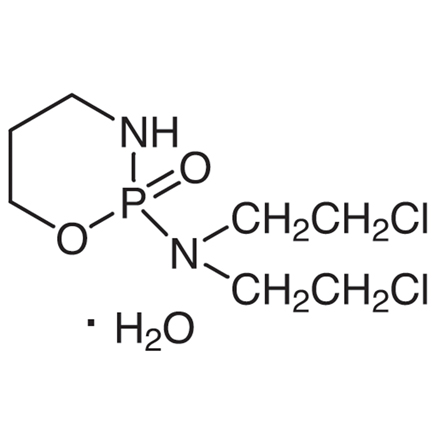
×

Reinheit: >98.0%(N)
Synonyme
- 2-[Bis(2-chloroethyl)amino]tetrahydro-1,3,2-oxazaphosphorin-2-oxide Monohydrate
Produktdokumente:
| Einheit | Stückpreis | Belgien | Japan* | Menge |
Versandinformationen

|
|---|---|---|---|---|---|
| 5G |
85,00 €
|
1 | ≥100 |
|
|
| 25G |
328,00 €
|
2 | 27 |
|
*Lagerbestand in Belgien: Versand am selben Tag
*Lagerbestand in Japan: Bitte prüfen Sie die Versandsimulation für voraussichtliche Lieferzeiten. (ausgenommen regulierte Produkte und Trockeneissendungen)


| Artikel # | C2236 |
Reinheit / Analysenmethode 
|
>98.0%(N) |
| Summenformel / Molekülmasse | C__7H__1__5Cl__2N__2O__2P·H__2O = 279.10 |
| Physikalischer Zustand (20 °C) | Solid |
| Lagerungstemperatur
|
Refrigerated (0-10°C) |
| Unter Inertgas lagern | Store under inert gas |
| Zu vermeidende Bedingungen | Light Sensitive,Air Sensitive,Heat Sensitive |
| CAS RN | 6055-19-2 |
| Verwandte CAS RN
|
50-18-0 |
| Reaxys Registrierungsnummer | 8167897 |
| PubChem-Stoff-ID | 125307342 |
| Merck-Index (14) | 2747 |
| MDL-Nummer | MFCD00149395 |
Spezifikation
| Appearance | White to Almost white powder to crystal |
| Purity(with Total Nitrogen) | min. 98.0 % |
| Melting point | 49.0 to 53.0 °C |
| Water | max. 8.0 % |
| NMR | confirm to structure |
Eigenschaften
| Schmelzpunkt | 51 °C |
| Löslichkeit in Wasser | Slightly soluble |
| Löslichkeit (löslich in) | Ether |
GHS
| Piktogramm |


|
| Signalwort | Gefahr |
| Gefahrenhinweise | H301 : Giftig bei Verschlucken. H315 : Verursacht Hautreizungen. H362 : Kann Säuglinge über die Muttermilch schädigen. H340 : Kann genetische Defekte verursachen. H350 : Kann Krebs erzeugen. |
| Sicherheitshinweise | P263 : Berührung während Schwangerschaft und Stillzeit vermeiden. P260 : Staub nicht einatmen. P202 : Vor Gebrauch alle Sicherheitshinweise lesen und verstehen. P201 : Vor Gebrauch besondere Anweisungen einholen. P280 : Schutzhandschuhe/ Schutzkleidung/ Augenschutz/ Gesichtsschutz/ Gehörschutz Tragen. P308 + P313 : BEI Exposition oder falls betroffen: Ärztlichen Rat einholen/ ärztliche Hilfe hinzuziehen. P301 + P310 + P330 : BEI VERSCHLUCKEN: Sofort GIFTINFORMATIONSZENTRUM/Arzt anrufen. Mund ausspülen. |
Verwandte Gesetze:
| EC-Nummern | 200-015-4 |
| RTECS # | RP6157750 |
Transportinformationen:
| UN-Nummer | UN3464 |
| Klasse | 6.1 |
| Verpackungsgruppe (DOT-AIR) | III |
| HS-Nr. (Import / Export) (TCI-E) | 2934999090 |
Anwendung
Reagent for cystitis model
References
- Uroprotective effect of pentoxifylline in cyclophosphamide-induced hemorrhagic cystitis in rats
- Relevance of the cyclophosphamide-induced cystitis model for pharmacological studies targeting inflammation and pain of the bladder
- Effect of intrathecal administration of E-series prostaglandin 1 receptor antagonist in a cyclophosphamide-induced cystitis rat model
- Effect of silymarin on bladder overactivity in cyclophosphamide-induced cystitis rat model

Anwendung
Reagent for hematopoietic disorder model
References
- A rabbit used as a model for testing hematopoietic tissue transplants
- S. Kosi?ski, H. Matej, Arch. Immunol. Ther. Exp. (Warsz) 1978, 26, 1021.
- Immunomodulatory effects of moxifloxacin in comparison to ciprofloxacin and G-CSF in a murine model of cyclophosphamide-induced leukopenia
Anwendung
Reagent for overactive bladder model
References
- Cyclophosphamide cystitis--identification of acrolein as the causative agent
- Cyclophosphamide cystitis in rats: involvement of capsaicin-sensitive primary afferents
- Increased excitability of afferent neurons innervating rat urinary bladder after chronic bladder inflammation
- Cyclophosphamide cystitis in mice: behavioural characterisation and correlation with bladder inflammation
- Cyclophosphamide-induced cystitis in freely-moving conscious rats: behavioral approach to a new model of visceral pain
- Comparison of voiding function and nociceptive behavior in two rat models of cystitis induced by cyclophosphamide or acetone
Anwendung
Reagent for nausea or vomiting model
References
- The antiemetic effect of a novel tropisetron patch in anticancer agents-induced kaolin pica model using rats
- The anti-cancer drug-induced pica in rats is related to their clinical emetogenic potential
Anwendung
Reviews on the Pharmacology of Cyclophosphamide
References
- An overview of cyclophosphamide and ifosfamide pharmacology
- R. A. Fleming, Pharmacotherapy 1997, 17, 146S.
- Cyclophosphamide: Review of its mutagenicity for an assessment of potential germ cell risks
- The chemistry of the metabolites of cyclophosphamide
- S. M. Ludeman, Curr. Pharm. Des. 1999, 5, 627.
- Mechanisms of resistance to the toxicity of cyclophosphamide
- M. P. Gamcsik, M. E. Dolan, B. S. Andersson, D. Murray, Curr. Pharm. Des. 1999, 5, 587.
Anwendung
Preparation
Reference
Anwendung
Optical resolution study
Reference
- Optical resolution studies of cyclophosphamide
PubMed Literatur
Dokumente
Produktartikel
Produktdokumente (Hinweis: Für einige Produkte sind keine Analysediagramme verfügbar.)
TCI Produktnummer eingeben
text.certificate.product.input.placeholder.kishida
4-5 alphanumerische Zeichen vor dem Bindestrich
text.certificate.lotno.input.placeholder.kishida
Sicherheitsdatenblatt (SDB)
Bitte wählen Sie Sprache.
Das angeforderte SDB ist nicht verfügbar.
Bitte Kontaktieren Sie uns für mehr Informationen.
• text.sds.search.errormsg.content.1.kishida
Spezifikationsdokumenten
Die angeforderten Spezifikationen sind nicht verfügbar.
Bitte Kontaktieren Sie uns für mehr Informationen.
text.specification.search.errormsg.content.1.kishida
AZ & andere Zertifikate
Bitte geben Sie die Lotnummer ein
Falsche Chargennummer wurde eingegeben. Bitte geben Sie nur 4-5 alphanumerische Zeichen vor dem Bindestrich ein.
text.certificate.analysis.pdf.lotNumber.errorMessage.alphanumeric.kishida
• Bitte überprüfen Sie, ob die von Ihnen eingegebene Chargennummer korrekt ist. Sie besteht aus 4-5 alphanumerischen Zeichen vor dem Bindestrich. Bitte prüfen Sie sorgfältig, ob O (Alphabet) oder 0 (Zahl), "I (Alphabet) oder 1 (Zahl) im Besonderen.
• Wenn Ihre Eingabe korrekt ist und Sie dennoch das Zerifikat nicht angezeigt bekommen, kontaktieren Sie uns bitte.
• text.certificate.analysis.pdf.errormsg.content6.kishida
Muster-AZ
Dies ist ein Muster-AZ und repräsentiert möglicherweise nicht eine kürzlich hergestellte Charge des Produkts.
Ein Muster-AZ für dieses Produkt ist zur Zeit nicht verfügbar.
Analytische Diagramme
Bitte geben Sie die Lotnummer ein
Falsche Chargennummer wurde eingegeben. Bitte geben Sie nur 4-5 alphanumerische Zeichen vor dem Bindestrich ein.
text.certificate.analysis.pdf.lotNumber.errorMessage.alphanumeric.kishida
Das angeforderte Analysediagramm ist nicht verfügbar. Wir entschuldigen uns für die Unannehmlichkeiten.