


Published TCIMAIL newest issue No.202
Maximum quantity allowed is 999
Bitte wählen Sie die Menge aus.
CAS RN: 404-86-4 | Produkte #: M1149
Capsaicin (Natural)

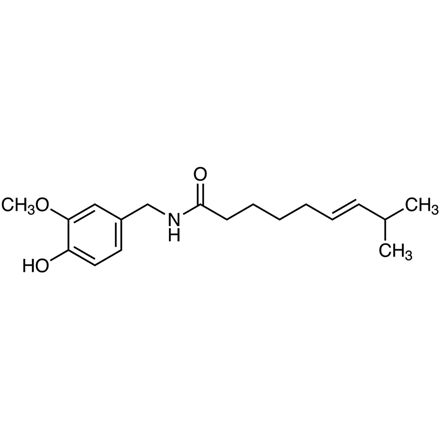
×

Reinheit: >60.0%(HPLC)
Synonyme
- N-[(4-Hydroxy-3-methoxyphenyl)methyl]-8-methyl-6-nonenamide
- 8-Methyl-N-vanillyl-6-nonenamide
Produktdokumente:
| Einheit | Stückpreis | Belgien | Japan* | Menge |
Versandinformationen

|
|---|---|---|---|---|---|
| 1G |
€60.00
|
4 | ≥100 |
|
*Lagerbestand in Belgien: Versand am selben Tag
*Lagerbestand in Japan: Bitte prüfen Sie die Versandsimulation für voraussichtliche Lieferzeiten. (ausgenommen regulierte Produkte und Trockeneissendungen)


| Artikel # | M1149 |
Reinheit / Analysenmethode 
|
>60.0%(HPLC) |
| Summenformel / Molekülmasse | C__1__8H__2__7NO__3 = 305.42 |
| Physikalischer Zustand (20 °C) | Solid |
| Lagerungstemperatur
|
Room Temperature (Recommended in a cool and dark place, <15°C) |
| CAS RN | 404-86-4 |
| Reaxys Registrierungsnummer | 2816484 |
| PubChem-Stoff-ID | 87573112 |
| Merck-Index (14) | 1768 |
| MDL-Nummer | MFCD00017259 |
Spezifikation
| Appearance | White to Light yellow to Light orange powder to crystal |
| Purity(HPLC) | min. 60.0 area% |
| Total Nitrogen | 4.3 to 4.8 % |
| NMR | confirm to structure |
Eigenschaften
| Schmelzpunkt | 65 °C |
| Löslichkeit (löslich in) | Chloroform, Ethanol |
GHS
| Piktogramm |

|
| Signalwort | Gefahr |
| Gefahrenhinweise | H300 : Lebensgefahr bei Verschlucken. H315 : Verursacht Hautreizungen. H319 : Verursacht schwere Augenreizung. |
| Sicherheitshinweise | P501 : Inhalt/ Behälter einer anerkannten Abfallentsorgungsanlage zuführen. P270 : Bei Gebrauch nicht essen, trinken oder rauchen. P264 : Nach Gebrauch Haut gründlich waschen. P280 : Schutzhandschuhe/ Augenschutz/ Gesichtsschutz tragen. P337 + P313 : Bei anhaltender Augenreizung: Ärztlichen Rat einholen/ ärztliche Hilfe hinzuziehen. P301 + P310 + P330 : BEI VERSCHLUCKEN: Sofort GIFTINFORMATIONSZENTRUM/Arzt anrufen. Mund ausspülen. |
Verwandte Gesetze:
| EC-Nummern | 206-969-8 |
| RTECS # | RA8530000 |
Transportinformationen:
| UN-Nummer | UN3462 |
| Klasse | 6.1 |
| Verpackungsgruppe (DOT-AIR) | II |
| HS-Nr. (Import / Export) (TCI-E) | 2924297099 |
Anwendung
Efflux pump inhibitor
References
- Capsaicin, a novel inhibitor of the NorA efflux pump, reduces the intracellular invasion of Staphylococcus aureus

Anwendung
Reagent for pain model
References
- Activation of the cAMP transduction cascade contributes to the mechanical hyperalgesia and allodynia induced by intradermal injection of capsaicin
- Stimulation of deep somatic tissue with capsaicin produces long-lasting mechanical allodynia and heat hypoalgesia that depends on early activation of the cAMP pathway
- Comparison of antinociceptive actions of standard analgesics in attenuating capsaicin and nerve-injury-induced mechanical hypersensitivity
- Increased spinal release of excitatory amino acids following intradermal injection of capsaicin is reduced by a protein kinase G inhibitor
- Role of protein kinase A in phosphorylation of NMDA receptor 1 subunits in dorsal horn and spinothalamic tract neurons after intradermal injection of capsaicin in rats
- Capsaicin-induced sensitization of primate spinothalamic tract cells is prevented by a protein kinase C inhibitor
- Inhibitors of G-proteins and protein kinases reduce the sensitization to mechanical stimulation and the desensitization to heat of spinothalamic tract neurons induced by intradermal injection of capsaicin in the primate
- A new model of visceral pain and referred hyperalgesia in the mouse
Anwendung
Reagent for coughing model
References
- Mechanisms of capsaicin- and citric-acid-induced cough reflexes in guinea pigs
- Animal models of cough: literature review and presentation of a novel cigarette smoke-enhanced cough model in the guinea-pig
- Dynamic modelling of a challenge-escalation cross-over study of treatment of capsaicin-induced coughing
Anwendung
Reagent for acute inflammatory (ear edema) model
Reference
- Profile of capsaicin-induced mouse ear oedema as neurogenic inflammatory model: comparison with arachidonic acid-induced ear oedema
PubMed Literatur
Dokumente
Produktartikel
Produktdokumente (Hinweis: Für einige Produkte sind keine Analysediagramme verfügbar.)
TCI Produktnummer eingeben
text.certificate.product.input.placeholder.kishida
4-5 alphanumerische Zeichen vor dem Bindestrich
text.certificate.lotno.input.placeholder.kishida
Sicherheitsdatenblatt (SDB)
Bitte wählen Sie Sprache.
Das angeforderte SDB ist nicht verfügbar.
Bitte Kontaktieren Sie uns für mehr Informationen.
• text.sds.search.errormsg.content.1.kishida
Spezifikationsdokumenten
Die angeforderten Spezifikationen sind nicht verfügbar.
Bitte Kontaktieren Sie uns für mehr Informationen.
text.specification.search.errormsg.content.1.kishida
AZ & andere Zertifikate
Bitte geben Sie die Lotnummer ein
Falsche Chargennummer wurde eingegeben. Bitte geben Sie nur 4-5 alphanumerische Zeichen vor dem Bindestrich ein.
text.certificate.analysis.pdf.lotNumber.errorMessage.alphanumeric.kishida
• Bitte überprüfen Sie, ob die von Ihnen eingegebene Chargennummer korrekt ist. Sie besteht aus 4-5 alphanumerischen Zeichen vor dem Bindestrich. Bitte prüfen Sie sorgfältig, ob O (Alphabet) oder 0 (Zahl), "I (Alphabet) oder 1 (Zahl) im Besonderen.
• Wenn Ihre Eingabe korrekt ist und Sie dennoch das Zerifikat nicht angezeigt bekommen, kontaktieren Sie uns bitte.
• text.certificate.analysis.pdf.errormsg.content6.kishida
Muster-AZ
Dies ist ein Muster-AZ und repräsentiert möglicherweise nicht eine kürzlich hergestellte Charge des Produkts.
Ein Muster-AZ für dieses Produkt ist zur Zeit nicht verfügbar.
Analytische Diagramme
Bitte geben Sie die Lotnummer ein
Falsche Chargennummer wurde eingegeben. Bitte geben Sie nur 4-5 alphanumerische Zeichen vor dem Bindestrich ein.
text.certificate.analysis.pdf.lotNumber.errorMessage.alphanumeric.kishida
Das angeforderte Analysediagramm ist nicht verfügbar. Wir entschuldigen uns für die Unannehmlichkeiten.