Sign up for free shipping on all website orders, no minimum required, and get exclusive coupons!
TCI offers bulk solutions for a wide range of chemical reagents. Get a Quote for Your Bulk Chemical Requirements.
Maximum quantity allowed is 999

| Taille | Prix unitaire | Philadelphia, PA | Portland, OR | Japon * | Quantité |
Informations d'expédition

|
|---|---|---|---|---|---|---|
| 1G |
$300.00
|
Expédié de Portland le jour même* | 1 | 1 |
|
* Les articles en stock local sont généralement expédiés le jour même de la commande. Les articles en stock au Japon peuvent être expédiés depuis un entrepôt américain dans les deux semaines suivant la commande. Pour obtenir une estimation plus précise des délais d’expédition, veuillez consulter l’outil de simulation d’expédition. Remarque : Sont exclus les articles réglementés ainsi que les articles nécessitant un envoi sous glace.
*Les articles en stock localement sont expédiés dans un délai de 1 à 2 jours. Les articles en stock au Japon peuvent être expédiés depuis un entrepôt aux Etats-Unis dans un délai de 2 semaines. Veuillez contacter TCI pour connaître les délais de livraison des articles qui ne sont pas en stock. Cela ne concerne par les articles réglementés et les articles expédiés sur carboglace.
*TCI révise régulièrement les conditions de stockage afin de les optimiser. Veuillez noter que les informations les plus récentes sur la température de stockage des produits sont disponibles sur notre site web.
| Numéro de produit | P2161 |
Pureté / Méthode d'analyse 
|
>98.0%(T) |
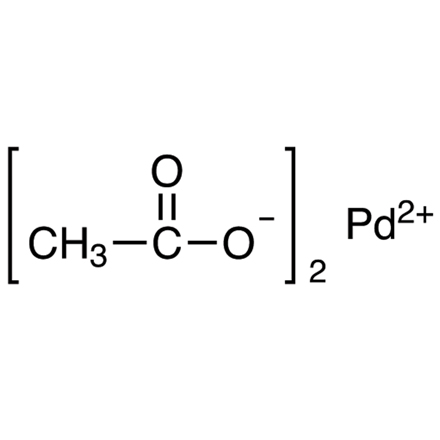
| Formule moléculaire / poids moléculaire | C__4H__6O__4Pd = 224.51 |
| Etat physique (20 ° C) | Solid |
| Condition de stockage
|
Room Temperature (Recommended in a cool and dark place, <15°C) |
| Emballage Et Conteneur
|
1G-Glass Bottle with Plastic Insert (Voir l'image) |
| CAS RN | 3375-31-3 |
| Numéro de registre de Reaxys | 3602276 |
| Identifiant de la substance PubChem | 253662088 |
| SDBS | 12841 |
| Indice Merck (14) | 6991 |
| Numéro MDL | MFCD00012453 |
| Appearance | Light yellow to Brown powder to crystal |
| Purity(Chelometric Titration) | min. 98.0 % |
| Elemental analysis(Nitrogen) | max. 0.30 % |
| Point de fusion | 205 °C |
| Longueur d'onde maximale | 400 nm (EtOH) |
| Solubilité (soluble dans) | Acetone |
| Pictogramme |


|
| Mot de signal | Danger |
| Mentions de danger | H318 : Provoque des lésions oculaires graves. H317 : Peut provoquer une allergie cutanée. H410 : Très toxique pour les organismes aquatiques, entraîne des effets néfastes à long terme. |
| Conseils de prudence | P501 : Eliminer le contenu/ le conteneur dans une installation d'élimination des déchets agréée. P261 : Éviter de respirer les poussières. P273 : Éviter le rejet dans l'environnement. P280 : Porter des gants de protection/ un équipement de protection des yeux/ un équipement de protection du visage. null P391 : Recueillir le produit répandu. P302 + P352 : EN CAS DE CONTACT AVEC LA PEAU: Laver abondamment à l'eau et au savon. P333 + P313 : En cas d'irritation ou d'éruption cutanée: Consulter un médecin. P363 : Laver les vêtements contaminés avant réutilisation. P305 + P351 + P338 + P310 : EN CAS DE CONTACT AVEC LES YEUX: Rincer avec précaution à l'eau pendant plusieurs minutes. Enlever les lentilles de contact si la victime en porte et si elles peuvent être facilement enlevées. Continuer à rincer. Appeler immédiatement un CENTRE ANTIPOISON ou un médecin. |
| RTECS # | AJ1900000 |
| Numéro UN (DOT-AIR) | UN3077 |
| Classe d'affichage (DOT-AIR) | 9 |
| Packing Group (TCI-A) | III |
| Numéro du SH (importation) (TCI-A) | 2843.90.0000 |

To the solution of 3-iodobenzalehyde (1.16 g, 5.00 mmol) in dry DMF (15.0 mL) were added potassium acetate (981 mg, 10.0 mmol), palladium(II) acetate (112 mg, 0.500 mmol, 10 mol%) and bis(pinacolato)diborane (1.27 g, 5.00 mmol). The reaction mixture was stirred at 80 ºC for 7 h. The reaction mixture was cooled to room temperature and quenched with H2O (15 mL) and saturated NH4Cl aq. (10 mL), then the mixture was extracted twice with hexane : EtOAc = 4 : 1. The combined organic layer was washed with H2O (50 mL) and brine (50 mL), dried over Na2SO4, and concentrated under reduced pressure to afford the crude product as a yellow oil. The crude product was purified by column chromatography on silica-gel (hexane → hexane : EtOAc = 1:1) to afford 3-formylphenylboronic acid pinacol ester as a yellow oil (500 mg, 2.15 mmol, 43%).
(1) DMF was dried over molecular sieves.
(2) Completion of the reaction was confirmed by TLC (hexane : EtOAc = 1 : 1, Rf = 0.30) and GC.
1H NMR (400 MHz, CDCl3); δ 10.1 (s, 1H), 8.30 (s, 1H), 8.06 (d, J = 4.0 Hz, 1H), 7.99 (ddd, J = 1.6, 1.8, 7.8 Hz, 1H), 7.53 (t, J = 8.0 Hz, 1H), 1.37 (s, 12H).

To a solution of 4-bromophenol (1.5 g, 8.7 mmol) in triethylamine (10 mL), styrene (1.1 g, 10.8 mmol), tri(o-tolyl)phosphine (0.16 g, 0.52 mmol) and palladium(II) acetate (0.020 g, 0.087 mmol) were successively added at room temperature. The reaction mixture was stirred overnight at 100 °C under nitrogen atmosphere. To a 1 mol/L HCl aq. (100 mL) the reaction mixture was added below 15 °C. Then diethyl ether (100 mL) was added and the mixture was stirred for 10 min. The solution was partitioned and the water phase was extracted by diethyl ether (50 mL). Then combined organic layer was dried over sodium sulfate and filtered. The residue was recrystallized from toluene giving trans-4-hydroxystilbene as a pale brown solid (0.97 g, 57% yield).
The reaction mixture was monitored by 1H NMR.
1H NMR (400 MHz, CDCl3); δ 9.59 (s, 1H), 7.53 (d, J = 7.3 Hz, 2H), 7.42 (d, J = 8.2 Hz, 2H), 7.34 (dd, J = 7.8, 7.3 Hz, 2H), 7.22 (t, J = 7.3 Hz, 1H), 7.15 (d, J = 16.5 Hz, 1H), 7.01 (d, J = 16.5 Hz, 1H), 6.77 (d, J = 8.7 Hz, 2H).
13C NMR (101 MHz, CDCl3); δ 157.3, 137.6, 128.7 (2 C), 128.5, 128.1, 127.9 (2 C), 127.0, 126.1 (2 C), 125.1, 115.6 (2 C).

To a solution of sodium tert-butoxide (0.54 g, 5.6 mmol), palladium(II) acetate (4.5 mg, 0.020 mmol), and JohnPhos (0.012 g, 0.040 mmol) in toluene (8 mL) 4-chlorotoluene (0.51 g, 4.0 mmol) and morpholine (0.42 g, 4.8 mmol) were successively added at room temperature. The mixture was stirred under nitrogen atmosphere at room temperature for 1.5 days, then under reflux condition for 0.5 days. Diethyl ether (20 mL) was added to the reaction mixture and filtered through celite. Solvent was removed and the residue was purified by column chromatography (1:4 ethyl acetate / hexane on SiO2), giving 4-(p-tolyl)morpholine as a pale brown solid (0.45 g, 63% yield).
The reaction mixture was monitored by 1H NMR.
1H NMR (400 MHz, CDCl3); δ 7.10 (d, J = 8.2 Hz, 2H), 6.85 (d, J = 8.2 Hz, 2H), 3.87 (t, J = 4.6 Hz, 4H), 3.12 (t, J = 4.8 Hz, 4H), 2.28 (s, 3H).
13C NMR (101 MHz, CDCl3); δ 129.9 (4 C), 116.2 (2 C), 67.1 (2 C), 50.1 (2 C), 20.6.

To a solution of palladium(II) acetate (44.9 mg, 0.200 mmol, 4 mol%), XPhos (143 mg, 0.300 mmol, 6 mol%), cesium fluoride (2.28 g, 15.0 mmol) and 2-chlorophenothiazine (1.17 g, 5.00 mmol) in toluene (15.0 mL) was added tributyl(2-thienyl)tin (2.24 g, 1.90 mL, 6.00 mmol) and the reaction solution was stirred at 80 ºC for 24 h. After reaction mixture was cooled to room temperature, dichloromethane (15 mL) and H2O (15 mL) were added. Separated water phase was extracted with dichloromethane (15 mL) for 3 times. Combined organic layer was dried over MgSO4 (10 g) and concentrated under reduced pressure to afford the crude product as a brown solid. Crude was purified by column chromatography on silica-gel (hexane: EtOAc = 50 : 1 ~ 5 : 1 → dichloromethane) to afford 2-(thiophen-2-yl)-10H-phenothiazine as a yellow solid (990 mg, 3.51 mmol, 70%).
Completion of the reaction was confirmed by TLC (Hexane:EtOAc = 10:1, Rf: S.M.=0.28 T.M.=0.18) and GC.
1H NMR (400 MHz, CDCl3); δ 7.92 (brs, 1H), 7.42 (dd, J = 0.9, 5.0 Hz, 1H), 7.35 (dd, J = 0.9, 3.6 Hz, 1H), 7.08-7.13 (m, 2H), 6.94-7.03 (m, 4H), 6.73-6.82 (m, 2H).

La FDS demandée n'est pas disponible.
Nous contacter pour plus d'informations.
• text.sds.search.errormsg.content.1.kishida
Les spécifications demandées ne sont pas disponibles.
Nous contacter pour plus d'informations.
text.specification.search.errormsg.content.1.kishida
• Veuillez vérifier que le numéro de lot que vous avez saisi est correct. Il s'agit de 4 à 5 caractères alphanumériques avant le trait d'union. Veuillez vérifier soigneusement si O (alphabet) ou 0 (chiffre), "I (alphabet) ou 1 (chiffre) en particulier.
• Si les informations sont correctes et que vous ne pouvez toujours pas voir le certificat demandé, veuillez nous contacter.
• text.certificate.analysis.pdf.errormsg.content6.kishida
Un échantillon CoA pour ce produit n'est pas disponible pour le moment.
Le tableau analytique demandé n'est pas disponible. Nous sommes désolés pour ce désagrément.