


Published TCIMAIL newest issue No.201
Maximum quantity allowed is 999
Bitte wählen Sie die Menge aus.
CAS RN: 19350-66-4 | Produkte #: B6316
3,5-Bis(ethoxycarbonyl)-2,6-dimethyl-1,4-dihydropyridine-4-carboxylic Acid


×

Reinheit: >95.0%(T)(HPLC)
Synonyme
- 2,6-Dimethyl-1,4-dihydropyridine-3,4,5-tricarboxylic Acid 3,5-Diethyl Ester
- 3,5-Bis(ethoxycarbonyl)-2,6-dimethyl-1,4-dihydro-4-pyridinecarboxylic Acid
Produktdokumente:
| Einheit | Stückpreis | Belgien | Japan* | Menge |
Versandinformationen

|
|---|---|---|---|---|---|
| 1G |
€ 86,00
|
1 | 18 |
|
|
| 10G |
€ 264,00
|
1 | 24 |
|
*Lagerbestand in Belgien: Versand am selben Tag
*Lagerbestand in Japan: Bitte prüfen Sie die Versandsimulation für voraussichtliche Lieferzeiten. (ausgenommen regulierte Produkte und Trockeneissendungen)


| Artikel # | B6316 |
Reinheit / Analysenmethode 
|
>95.0%(T)(HPLC) |
| Summenformel / Molekülmasse | C__1__4H__1__9NO__6 = 297.31 |
| Physikalischer Zustand (20 °C) | Solid |
| Lagerungstemperatur
|
Room Temperature (Recommended in a cool and dark place, <15°C) |
| Unter Inertgas lagern | Store under inert gas |
| Zu vermeidende Bedingungen | Air Sensitive |
| Verpackung und Behälter
|
1G-Glass Bottle with Plastic Insert (Bild ansehen) |
| CAS RN | 19350-66-4 |
| Reaxys Registrierungsnummer | 489397 |
| PubChem-Stoff-ID | 468591034 |
| MDL-Nummer | MFCD00417306 |
Spezifikation
| Appearance | White to Light yellow powder to crystal |
| Purity(HPLC) | min. 95.0 area% |
| Purity(Neutralization titration) | min. 95.0 % |
| NMR | confirm to structure |
Eigenschaften
| Schmelzpunkt | 220 °C |
GHS
| Piktogramm |

|
| Signalwort | Achtung |
| Gefahrenhinweise | H315 : Verursacht Hautreizungen. H319 : Verursacht schwere Augenreizung. |
| Sicherheitshinweise | P264 : Nach Gebrauch Haut gründlich waschen. P280 : Schutzhandschuhe/ Augenschutz/ Gesichtsschutz tragen. P302 + P352 : BEI BERÜHRUNG MIT DER HAUT: Mit viel Wasser waschen. P337 + P313 : Bei anhaltender Augenreizung: Ärztlichen Rat einholen/ ärztliche Hilfe hinzuziehen. P362 + P364 : Kontaminierte Kleidung ausziehen und vor erneutem Tragen waschen. P332 + P313 : Bei Hautreizung: Ärztlichen Rat einholen/ ärztliche Hilfe hinzuziehen. |
Verwandte Gesetze:
Transportinformationen:
| HS-Nr. (Import / Export) (TCI-E) | 2933399999 |
Anwendung
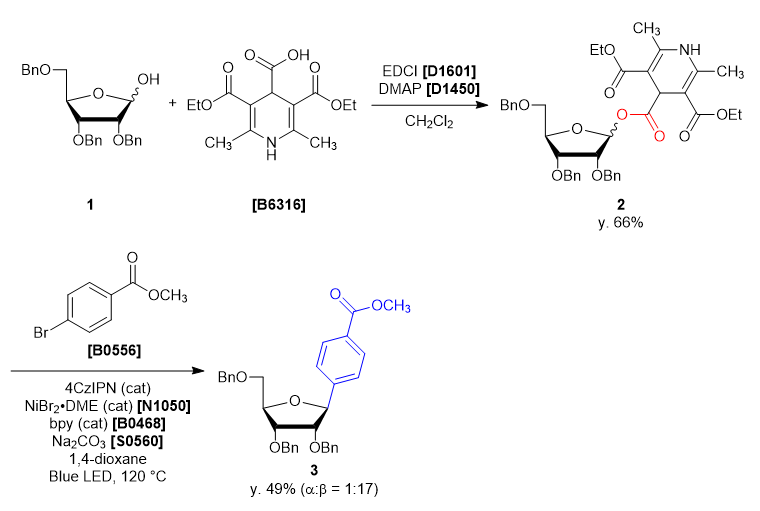
TCI Practical Example: The Synthesis of the C-Aryl Glycoside through the Cross-Coupling of the Glycosyl Dihydoropyridine (DHP) Ester Precursor
-
Used Chemicals
-
- 3,5-Bis(ethoxycarbonyl)-2,6-dimethyl-1,4-dihydropyridine-4-carboxylic Acid [B6316]
- 2,3,5-Tri-O-benzyl-α/β-D-ribofuranose (1)
- 4-Dimethylaminopyridine (= DMAP) [D1450]
- 1-(3-Dimethylaminopropyl)-3-ethylcarbodiimide Hydrochloride (= EDCI) [D1601]
- Dichloromethane
- Sodium Carbonate [S0560]
- 1,2,3,5-Tetrakis(carbazol-9-yl)-4,6-dicyanobenzene (= 4CzIPN)
- Methyl 4-Bromobenzoate [B0556]
- 2,2'-Bipyridyl (= bpy) [B0468]
- Nickel(II) Bromide Ethylene Glycol Dimethyl Ether Complex (= NiBr2・DME) [N1050]
- 1,4-Dioxane
-
Procedure
-
A four-neck round bottom flask was charged with 2,3,5-tri-O-benzyl-α/β-D-ribofuranose (1) (2.165 g, 5.15 mmol, 1 eq) and dichloromethane (26 mL). The solution was cooled under 5 ˚C, then DMAP (0.063 g, 0.51 mmol, 0.1 eq), EDCI (1.38 g, 7.21 mmol, 1.4 eq), 3,5-bis(ethoxycarbonyl)-2,6-dimethyl-1,4-dihydropyridine-4-carboxylic acid (1.684 g, 5.66 mmol, 1.1 eq) was added. The reaction mixture was allowed to warm to ambient temperature and stirred for 46 h. After the reaction, the reaction mixture was quenched with ion-exchanged water (35 mL). The solution was transferred into a separatory funnel, and the aqueous layer was extracted with dichloromethane (10 mL, twice). The combined organic layers were washed with brine, dried over sodium sulfate (10 g) for about 30 minutes and then filtered. The solvent was removed in vacuo, giving crude as a blown oil (3.91 g). The crude was purified by silica gel column chromatography (hexane:ethyl acetate = 1:1, Rf = 0.45) to give compound 2 as a light yellow oil (2.99 g, y. 66%).
30 mL sealed vessel was charged with 4CzIPN (0.0158 g, 0.020 mmol, 0.1 eq), methyl 4-bromobenzoate (0.0858 g, 0.399 mmol, 2.0 eq), sodium carbonate (0.0443 g, 0.418 mmol, 2.1 eq), 2,2’-bipyridine (0.0086 g, 0.055 mmol, 0.28 eq) at rt under N2. A solution of NiBr2・DME (0.012 g, 0.040 mmol, 0.20 eq) in 1,4-dioxane (5 mL) and the solution of 1 (0.14 g, 0.20 mmol, 1.0 eq) in 1,4-dioxane (5 mL) were added to the sealed vessel. The mixture was placed in a preheated oil bath whose temperature was set to 120 ˚C, and placed at a distance of 2-3 cm from Blue LED lamp. After irradiation for 46 h, the reaction mixture was cooled to room temperature and filtered through Celite pad (1 cm). The solvent was removed in vacuo and the crude was given as a yellow oil (0.23 g). The crude was purified by silica gel column chromatography (hexane:ethyl acetate = 10:2, Rf = 0.30) to give compound 3 as a colorless oil (0.053 g, y. 49%). -
-
Experimenter’s Comments
-
- NiBr2・DME was weighed in a nitrogen-filled glove box and dissolved in 1,4-dioxane completely using a sonication.
- 1,4-Dioxane was degassed with nitrogen for 30 min before use.
- Irradiation of visible light was performed with Kessil A160WE Tuna Blue 40W x 2.
- The reaction mixture was monitored by 1H NMR and UPLC.
- The α/β selectivity of 3 was 1:17.
-
Analytical Data
-
Compound 3
1H NMR (270 MHz, CDCl3); δ 7.96 (d, J = 8.2 Hz, 2H), 7.46 (d, J = 8.2 Hz, 2H), 7.40-7.30 (m, 11H), 7.26-7.23 (m, 2H), 7.18-7.15 (m, 2H), 5.05 (d, J = 6.9 Hz, 1H), 4.71-4.44 (m, 6H), 4.39-4.34 (m, 1H), 4.01 (dd, J = 5.3, 3.3 Hz, 1H), 3.92 (s, 3H), 3.77 (dd, J = 6.9, 5.3 Hz, 1H), 3.65 (qd, J = 10.6, 3.9 Hz, 2H).
-
Lead Reference
-
- Diastereoselective Synthesis of Aryl C-Glycosides from Glycosyl Esters via C-O Bond Homolysis

-
Other Reference
-
- Highly stereoselective synthesis of aryl/heteroaryl-C-nucleosides via the merger of photoredox and nickel catalysis
Dokumente
Produktartikel
[TCI Practical Example] The Synthesis of the C-Aryl Glycoside through the Cross-Coupling of the Glycosyl Dihydoropyridinecarboxylic Acid Precursor[TCIMAIL No.200] Dihydropyridine Derivative for Photoredox Reactions
Produktdokumente (Hinweis: Für einige Produkte sind keine Analysediagramme verfügbar.)
TCI Produktnummer eingeben
text.certificate.product.input.placeholder.kishida
4-5 alphanumerische Zeichen vor dem Bindestrich
text.certificate.lotno.input.placeholder.kishida
Sicherheitsdatenblatt (SDB)
Bitte wählen Sie Sprache.
Das angeforderte SDB ist nicht verfügbar.
Bitte Kontaktieren Sie uns für mehr Informationen.
• text.sds.search.errormsg.content.1.kishida
Spezifikationsdokumenten
Die angeforderten Spezifikationen sind nicht verfügbar.
Bitte Kontaktieren Sie uns für mehr Informationen.
text.specification.search.errormsg.content.1.kishida
AZ & andere Zertifikate
Bitte geben Sie die Lotnummer ein
Falsche Chargennummer wurde eingegeben. Bitte geben Sie nur 4-5 alphanumerische Zeichen vor dem Bindestrich ein.
text.certificate.analysis.pdf.lotNumber.errorMessage.alphanumeric.kishida
• Bitte überprüfen Sie, ob die von Ihnen eingegebene Chargennummer korrekt ist. Sie besteht aus 4-5 alphanumerischen Zeichen vor dem Bindestrich. Bitte prüfen Sie sorgfältig, ob O (Alphabet) oder 0 (Zahl), "I (Alphabet) oder 1 (Zahl) im Besonderen.
• Wenn Ihre Eingabe korrekt ist und Sie dennoch das Zerifikat nicht angezeigt bekommen, kontaktieren Sie uns bitte.
• text.certificate.analysis.pdf.errormsg.content6.kishida
Muster-AZ
Dies ist ein Muster-AZ und repräsentiert möglicherweise nicht eine kürzlich hergestellte Charge des Produkts.
Ein Muster-AZ für dieses Produkt ist zur Zeit nicht verfügbar.
Analytische Diagramme
Bitte geben Sie die Lotnummer ein
Falsche Chargennummer wurde eingegeben. Bitte geben Sie nur 4-5 alphanumerische Zeichen vor dem Bindestrich ein.
text.certificate.analysis.pdf.lotNumber.errorMessage.alphanumeric.kishida
Das angeforderte Analysediagramm ist nicht verfügbar. Wir entschuldigen uns für die Unannehmlichkeiten.