


Published TCIMAIL newest issue No.200
Maximum quantity allowed is 999
Bitte wählen Sie die Menge aus.
CAS RN: 17406-45-0 | Produkte #: T3636
Tomatine from Tomato

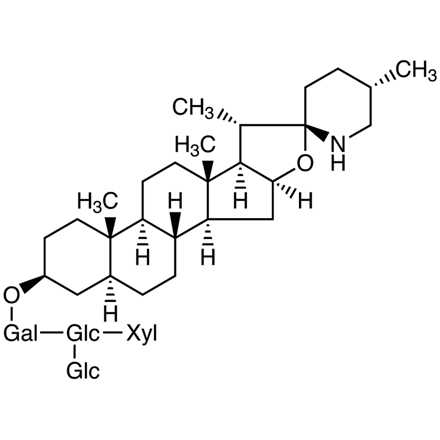
×

Reinheit: >80.0%(HPLC)
Synonyme
- α-Tomatine from Tomato
- Lycopersicin from Tomato
Produktdokumente:
| Einheit | Stückpreis | Belgien | Japan* | Menge |
Versandinformationen

|
|---|---|---|---|---|---|
| 100MG |
€158.00
|
Kontaktieren Sie uns | Kontaktieren Sie uns |
|
*Lagerbestand in Belgien: Versand am selben Tag
*Lagerbestand in Japan: Bitte prüfen Sie die Versandsimulation für voraussichtliche Lieferzeiten. (ausgenommen regulierte Produkte und Trockeneissendungen)


| Artikel # | T3636 |
Reinheit / Analysenmethode 
|
>80.0%(HPLC) |
| Summenformel / Molekülmasse | C__5__0H__8__3NO__2__1 = 1,034.20 |
| Physikalischer Zustand (20 °C) | Solid |
| Lagerungstemperatur
|
Room Temperature (Recommended in a cool and dark place, <15°C) |
| CAS RN | 17406-45-0 |
| Reaxys Registrierungsnummer | 78250 |
| PubChem-Stoff-ID | 354334699 |
| Merck-Index (14) | 9545 |
| MDL-Nummer | MFCD00016888 |
Spezifikation
| Appearance | White to Yellow to Orange powder to crystal |
| Purity(HPLC) | min. 80.0 area% |
| Specific rotation [a]20/D | -28.0 to -34.0 deg(C=0.5,Pyridine) |
| NMR | confirm to structure |
Eigenschaften
| Schmelzpunkt | 291 °C |
| Optische Aktivität | -33° (C=0.5,Pyridine) |
| Löslichkeit (löslich in) | Dioxane, Ethanol, Methanol |
GHS
| Piktogramm |

|
| Signalwort | Achtung |
| Gefahrenhinweise | H302 : Gesundheitsschädlich bei Verschlucken. |
| Sicherheitshinweise | P501 : Inhalt/ Behälter einer anerkannten Abfallentsorgungsanlage zuführen. P270 : Bei Gebrauch nicht essen, trinken oder rauchen. P264 : Nach Gebrauch Haut gründlich waschen. P301 + P312 + P330 : BEI VERSCHLUCKEN: Bei Unwohlsein GIFTINFORMATIONSZENTRUM/Arzt anrufen. Mund ausspülen. |
Verwandte Gesetze:
| EC-Nummern | 241-429-5 |
| RTECS # | XW1050000 |
Transportinformationen:
| HS-Nr. (Import / Export) (TCI-E) | 2939799090 |
Anwendung
Tomatine: A Steroidal Glycoalkaloid with a Wide Variety of Functions
Tomatine is a steroidal glycoalkaloid in the stems and leaves of the tomato plant (Lycopersicon esculentum) and other Lycopersicon and Solanum species. Tomatine was first discovered as an antifungal agent against Fusarium oxysporum f. (a tomato pathogen), in 1940s. Since then, tomatine has been reported its variety of functions, such as acholinesterase inhibitory and antioxidant activities, hypocholesterolemic, adjuvant and anticarcinogenic effects, and etc. Tomatine is also used as a starting compound for the synthesis of steroidal hormones. (The product is for research purpose only.)
References
- The steroidal glycoalkaloid α-tomatine (a review)
- The acetylcholinesterase-inhibitory activity of steroidal glycoalkaloids and their aglycones
- Antioxidative Activity and Carotenoid and Tomatine Contents in Different Typologies of Fresh Consumption Tomatoes
- Lowering of plasma LDL cholesterol in hamsters by the tomato glycoalkaloid tomatine
- Immunobiology of the Tomatine adjuvant
- Anticarcinogenic, cardioprotective, and other health benefits of tomato compounds lycopene, α-tomatine, and tomatidine in pure form and in fresh and processed tomatoes (a review)
- α-Tomatine Content in Tomato and Tomato Products Determined by HPLC with Pulsed Amperometric Detection

PubMed Literatur
Dokumente
Produktartikel
Produktdokumente (Hinweis: Für einige Produkte sind keine Analysediagramme verfügbar.)
Sicherheitsdatenblatt (SDB)
Bitte wählen Sie Sprache.
Das angeforderte SDB ist nicht verfügbar.
Bitte Kontaktieren Sie uns für mehr Informationen.
Spezifikationsdokumenten
AZ & andere Zertifikate
Bitte geben Sie die Lotnummer ein
Falsche Chargennummer wurde eingegeben. Bitte geben Sie nur 4-5 alphanumerische Zeichen vor dem Bindestrich ein.
Muster-AZ
Dies ist ein Muster-AZ und repräsentiert möglicherweise nicht eine kürzlich hergestellte Charge des Produkts.
Ein Muster-AZ für dieses Produkt ist zur Zeit nicht verfügbar.
Analytische Diagramme
Bitte geben Sie die Lotnummer ein
Falsche Chargennummer wurde eingegeben. Bitte geben Sie nur 4-5 alphanumerische Zeichen vor dem Bindestrich ein.
Das angeforderte Analysediagramm ist nicht verfügbar. Wir entschuldigen uns für die Unannehmlichkeiten.