The Mitsunobu reaction is a unique dehydration-condensation reaction between alcohols and various nucleophiles using the redox system comprised of diethyl azodicarboxylate (DEAD) and triphenylphosphine (TPP).1) The reactions proceed under mild conditions, and a wide variety of compounds can be used as nucleophiles, for example, carboxylic acids, active methylenes, imides, thiols, etc. The reaction between secondary alcohols and nucleophiles yields products with Walden inversion. The Mitsunobu reaction has been used widely in organic synthesis. Due to its utility, efforts have been made to expand application of the Mitsunobu reaction, and modified reactions have been reported.2)
For example, by using azodicarboxamides instead of azodicarboxylates the Mitsunobu reaction is being applied to weak-acidity nucleophiles with a higher pKa value.3) Methods have been reported for the easy removal of phosphine oxide, a reaction by-product, by utilizing phosphines which have an intramolecular basic component4) and diphenylphosphino polystyrene resin.5) The modified method using a catalytic amount of DEAD and a stoichiometric amount of PhI(OAc)2 as a reoxidizing reagent has also been reported, which makes it possible to dramatically reduce the hydrazine byproduct.6)

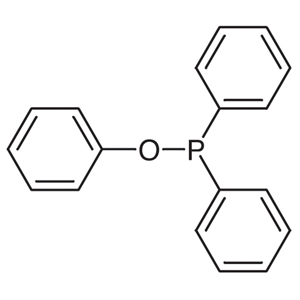
Moreover, the DEAD-TPP reaction system is generally not applicable to sterically-hindered tertiary alcohols. Mukaiyama and Kuroda et al. have reported the modified method using phenoxydiphenylphosphine (1), instead of TPP. In this system, condensation of tertiary alcohols and 2-nitrobenzoic acid affords the corresponding ester with inversion of the configuration as shown below.7)
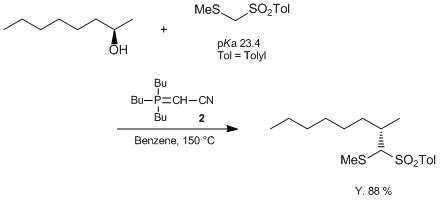
In 1994, Tsunoda and co-workers reported a new Mitsunobu reagent, cyanomethylenetributylphosphorane (2).8) This reagent alone can achieve the functions of DEAD and TPP. It is shown to be very effective in the reaction of secondary alcohols and active methylene of pKa value above 23.4. Accordingly, 2 is a reagent which increases the usefulness of the Mitsunobu reaction.
On exposure to heat, impact, friction, etc., azodicarboxylic acid derivatives are prone to highly exothermic reaction or explosive decomposition. Sufficient safety measures, such as usage of safety shield, wearing of protective equipment, and extreme caution should be taken, when using this compound, from the opening up to the disposal of the reagents.
References
- 1) O. Mitsunobu, Synthesis 1981, 1.

- 2) (a) S. Ito, Yakugaku Zasshi (J. Pharm. Soc. Jpn.) 2001, 121, 567.
- (b) T. Onozawa, TCIMAIL 1999, number 104, 10.
- 3) (a) T. Tsunoda, Y. Yamamiya, S. Ito, Tetrahedron Lett. 1993, 34, 1639.
- (b) T. Tsunoda, J. Otsuka, Y. Yamamiya, S. Ito, Chem. Lett. 1994, 539.
- (c) S. Ito, T. Tsunoda, Pure & Appl. Chem. 1994, 66, 2071.
- (d) T. Tsunoda, Y. Yamamiya, Y. Kawamura, S. Ito, Tetrahedron Lett. 1995, 36, 2529.
- (e) K. Tahara, T. Onozawa, Yuki Gosei Kagaku Kyokaishi (J. Synth. Org. Chem., Jpn.) 1999, 57, 633.
- 4) (a) L. D. Arnold, H. I. Assil, J. C. Vederas, J. Am. Chem. Soc. 1989, 111, 3973.
- 5) R. A. Amos, R. W. Emblidge, N. Havens, J. Org. Chem. 1983, 48, 3598.
- 6) (a) T. Tsunoda, M. Nagaku, C. Nagino, Y. Kawamura, F. Ozaki, H. Hiroki, S. Ito, Tetrahedron Lett. 1995, 36, 2531.
- 7) (a) K. Kuroda, Y. Maruyama, Y. Hayashi, T. Mukaiyama, Chem. Lett. 2008, 37, 836.
- (b) K. Kuroda, Y. Maruyama, Y. Hayashi, T. Mukaiyama, Bull. Chem. Soc. Jpn. 2009, 82, 381.
- (c) T. Mukaiyama, K. Kuroda, Y. Mukaiyama, Y. Hayashi, Chem. Lett. 2008, 37, 1072.
- (d) Review: T. Mukaiyama, K. Kuroda, Y. Maruyama, Heterocycles 2010, 80, 63.
- 8) (a) T. Tsunoda, M. Nagaku, C. Nagino, Y. Kawamura, F. Ozaki, H. Hiroki, S. Ito, Tetrahedron Lett. 1995, 36, 2531.
Page Top




![[1,2-Bis(ethoxycarbonyl)hydrazineyl]triphenylphosphonium Trifluoromethanesulfonate](/medias/Tci-300-B7082.jpg?context=bWFzdGVyfHJvb3R8MTA3NjV8aW1hZ2UvanBlZ3xhR0pqTDJnMU1pODVOakExTkRRM05ERTNPRGcyTDFSamFTMHpNREJmUWpjd09ESXVhbkJufGExOGYzNTRjZjlkN2U5Nzg0NjliY2U0MGQ2YTU3NDhmZjZmZTU5OGJmNTlmMmYxMzZiODk1ZDNlNTNmYTQwNDE "[1,2-Bis(ethoxycarbonyl)hydrazineyl]triphenylphosphonium Trifluoromethanesulfonate")


![2-[(Diphenylphosphoryl)methyl]phenol](/medias/H1763.jpg?context=bWFzdGVyfHJvb3R8MjEwNjF8aW1hZ2UvanBlZ3xhRGN5TDJnM1lTODVNVE00TURBMU1ERTJOakEyTDBneE56WXpMbXB3Wnd8ODg2NWViZWM3ZTEwZmNmNDlhMmQ4ZjA2NzQ0NWJlOGY3MDU5MjEwYzVmM2MzNGRkZjExYWFkMGM0ODY2M2FhYw "2-[(Diphenylphosphoryl)methyl]phenol")