
Maximum quantity allowed is 999
Please select the quantity
CAS RN: 6055-19-2 | Product Number: C2236
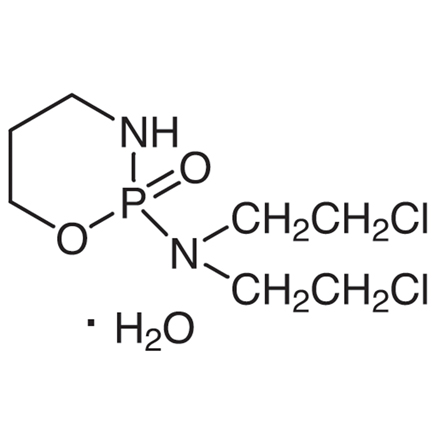
Cyclophosphamide Monohydrate

×

Purity: >98.0%(N)
Synonyms:
- 2-[Bis(2-chloroethyl)amino]tetrahydro-1,3,2-oxazaphosphorin-2-oxide Monohydrate
Product Documents:
| Size | Unit Price | Same Day | 2-3 Business Days | Other Lead Time |
Shipping Information

|
|---|---|---|---|---|---|
| 1G |
$45.00
|
4 | 0 | Contact Us | |
| 5G |
$139.00
|
2 | 0 | It can be shipped in about 2 weeks after ordering | |
| 25G |
$467.00
|
17 | 2 | It can be shipped in about 4-5 weeks after ordering |
* Please contact our distributors or
TCI
to order our products. The above prices do not include freight cost, customs, and other charges to the destination.
* The storage conditions are subject to change without notice.


| Product Number | C2236 |
Purity / Analysis Method 
|
>98.0%(N) |
| Molecular Formula / Molecular Weight | C__7H__1__5Cl__2N__2O__2P·H__2O = 279.10 |
| Physical State (20 deg.C) | Solid |
| Storage Temperature
|
Refrigerated (0-10°C) |
| Store Under Inert Gas | Store under inert gas |
| Condition to Avoid | Light Sensitive,Air Sensitive,Heat Sensitive |
| Packaging and Container
|
1G-Glass Bottle with Plastic Insert (View image) |
| CAS RN | 6055-19-2 |
| Related CAS RN
|
50-18-0 |
| Reaxys Registry Number | 8167897 |
| PubChem Substance ID | 125307342 |
| Merck Index (14) | 2747 |
| MDL Number | MFCD00149395 |
Specifications
| Appearance | White to Almost white powder to crystal |
| Purity(with Total Nitrogen) | min. 98.0 % |
| Melting point | 49.0 to 53.0 °C |
| Water | max. 8.0 % |
| NMR | confirm to structure |
Properties (reference)
| Melting Point | 51 °C |
| Solubility in water | Slightly soluble |
| Solubility (soluble in) | Ether |
GHS
| Pictogram |


|
| Signal Word | Danger |
| Hazard Statements | H301 : Toxic if swallowed. H315 : Causes skin irritation. H362 : May cause harm to breast-fed children. H340 : May cause genetic defects. H350 : May cause cancer. |
| Precautionary Statements | P501 : Dispose of contents/ container to an approved waste disposal plant. P263 : Avoid contact during pregnancy and while nursing. P260 : Do not breathe dust. P270 : Do not eat, drink or smoke when using this product. P202 : Do not handle until all safety precautions have been read and understood. P201 : Obtain special instructions before use. P264 : Wash skin thoroughly after handling. P280 : Wear protective gloves/ protective clothing/ eye protection/ face protection. P302 + P352 : IF ON SKIN: Wash with plenty of water. P308 + P313 : IF exposed or concerned: Get medical advice/ attention. P362 + P364 : Take off contaminated clothing and wash it before reuse. P332 + P313 : If skin irritation occurs: Get medical advice/ attention. P301 + P310 + P330 : IF SWALLOWED: Immediately call a POISON CENTER/doctor. Rinse mouth. P405 : Store locked up. |
Related Laws:
| RTECS# | RP6157750 |
Transport Information:
| UN Number | UN3464 |
| Class | 6.1 |
| Packing Group | III |
| H.S.code* | 2934.99-000 |
Application
Reagent for cystitis model
References
- Uroprotective effect of pentoxifylline in cyclophosphamide-induced hemorrhagic cystitis in rats
- Relevance of the cyclophosphamide-induced cystitis model for pharmacological studies targeting inflammation and pain of the bladder
- Effect of intrathecal administration of E-series prostaglandin 1 receptor antagonist in a cyclophosphamide-induced cystitis rat model
- Effect of silymarin on bladder overactivity in cyclophosphamide-induced cystitis rat model

Application
Reagent for hematopoietic disorder model
References
- A rabbit used as a model for testing hematopoietic tissue transplants
- S. Kosi?ski, H. Matej, Arch. Immunol. Ther. Exp. (Warsz) 1978, 26, 1021.
- Immunomodulatory effects of moxifloxacin in comparison to ciprofloxacin and G-CSF in a murine model of cyclophosphamide-induced leukopenia
Application
Reagent for overactive bladder model
References
- Cyclophosphamide cystitis--identification of acrolein as the causative agent
- Cyclophosphamide cystitis in rats: involvement of capsaicin-sensitive primary afferents
- Increased excitability of afferent neurons innervating rat urinary bladder after chronic bladder inflammation
- Cyclophosphamide cystitis in mice: behavioural characterisation and correlation with bladder inflammation
- Cyclophosphamide-induced cystitis in freely-moving conscious rats: behavioral approach to a new model of visceral pain
- Comparison of voiding function and nociceptive behavior in two rat models of cystitis induced by cyclophosphamide or acetone
Application
Reagent for nausea or vomiting model
References
- The antiemetic effect of a novel tropisetron patch in anticancer agents-induced kaolin pica model using rats
- The anti-cancer drug-induced pica in rats is related to their clinical emetogenic potential
Application
Reviews on the Pharmacology of Cyclophosphamide
References
- An overview of cyclophosphamide and ifosfamide pharmacology
- R. A. Fleming, Pharmacotherapy 1997, 17, 146S.
- Cyclophosphamide: Review of its mutagenicity for an assessment of potential germ cell risks
- The chemistry of the metabolites of cyclophosphamide
- S. M. Ludeman, Curr. Pharm. Des. 1999, 5, 627.
- Mechanisms of resistance to the toxicity of cyclophosphamide
- M. P. Gamcsik, M. E. Dolan, B. S. Andersson, D. Murray, Curr. Pharm. Des. 1999, 5, 587.
Application
Preparation
Reference
Application
Optical resolution study
Reference
- Optical resolution studies of cyclophosphamide
PubMed Literature
Documents
Product Articles
Product Documents (Note: Some products will not have analytical charts available.)
Enter TCI Product Number
Enter KISHIDA Product Number
4-5 alphanumeric characters before the hyphen
7 alphanumeric characters
Safety Data Sheet (SDS)
Please select Language.
The requested SDS is not available.
Please Contact Us for more information.
• The requested SDS is not available.
Specifications
The requested specifications are not available.
Please Contact Us for more information.
The requested specifications are not available.
C of A & Other Certificates
Please enter Lot Number
Incorrect Lot Number. Please input only the 4-5 alphanumeric characters before the hyphen.
Incorrect Lot Number. Please input only the 7 alphanumeric characters.
• Please check that the lot number you have entered is correct. It is 4-5 alphanumeric characters before the hyphen. In particular, please check O (letter) or 0 (number) and I (letter) or 1 (number).
• If your information is correct and you are still not able to view the requested certificates, Please Contact Us for more information.
• Please check that the lot number you have entered is correct. It is 7 alphanumeric characters. In particular, please check O (letter) or 0 (number) and I (letter) or 1 (number).
Sample C of A
This is a sample C of A and may not represent a recently manufactured lot of the product.
A sample C of A for this product is not available at this time.
Analytical Charts
Please enter Lot Number
Incorrect Lot Number. Please input only the 4-5 alphanumeric characters before the hyphen.
Incorrect Lot Number. Please input only the 7 alphanumeric characters.
The requested analytical chart is not available. Sorry for the inconvenience.