
Maintenance Notice (2:50 - 5:10 AM August 29, 2026 UTC): This website is scheduled to be unavailable due to maintenance. We appreciate your patience and understanding.
Published TCIMAIL newest issue No.202 | Product Document Searching Made Easy by 2D Code! | TCI Life Science News August 2026 | [Product Highlights] Easy-to-Use Membrane Protein... | Various analytical charts can be searched on each product detail page and Product Document Search (The kinds of analytical charts differ by product)
Maximum quantity allowed is 999
Please select the quantity
CAS RN: 546-67-8 | Product Number: L0021
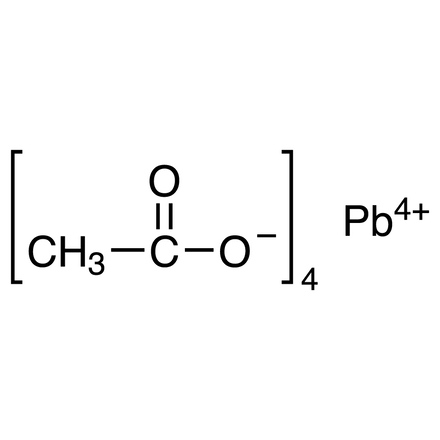
Lead Tetraacetate (contains Acetic Acid)

×

Purity: >96.0%(T)
Synonyms:
- LTA (contains Acetic Acid)
- Lead(IV) Acetate (contains Acetic Acid)
Product Documents:
| Size | Unit Price | Same Day | 2-3 Business Days | Other Lead Time |
Shipping Information

|
|---|---|---|---|---|---|
| 25G |
$65.00
|
0 | 0 | Contact Us | |
| 500G |
$464.00
|
0 | 0 | Contact Us |
* Please contact our distributors or
TCI
to order our products. The above prices do not include freight cost, customs, and other charges to the destination.
* The storage conditions are subject to change without notice.


| Product Number | L0021 |
Purity / Analysis Method 
|
>96.0%(T) |
| Molecular Formula / Molecular Weight | C__8H__1__2O__8Pb = 443.38 |
| Physical State (20 deg.C) | Solid |
| Storage Temperature
|
Refrigerated (0-10°C) |
| Store Under Inert Gas | Store under inert gas |
| Condition to Avoid | Air Sensitive,Moisture Sensitive,Heat Sensitive |
| CAS RN | 546-67-8 |
| Reaxys Registry Number | 3595640 |
| PubChem Substance ID | 87571991 |
| Merck Index (14) | 5423 |
| MDL Number | MFCD00008693 |
Specifications
| Appearance | White to Almost white powder to crystal |
| Purity(Iodometric Titration) | min. 96.0 % |
| NMR | confirm to structure |
Properties (reference)
| Solubility (soluble in) | Alcohol, Nitrobenzene, Benzene, Chloroform |
GHS
| Pictogram |


|
| Signal Word | Danger |
| Hazard Statements | H302 + H332 : Harmful if swallowed or if inhaled. H314 : Causes severe skin burns and eye damage. H360 : May damage fertility or the unborn child. H371 : May cause damage to organs. H373 : May cause damage to organs through prolonged or repeated exposure. H410 : Very toxic to aquatic life with long lasting effects. |
| Precautionary Statements | P501 : Dispose of contents/ container to an approved waste disposal plant. P273 : Avoid release to the environment. P260 : Do not breathe dust. P270 : Do not eat, drink or smoke when using this product. P202 : Do not handle until all safety precautions have been read and understood. P201 : Obtain special instructions before use. P271 : Use only outdoors or in a well-ventilated area. P264 : Wash skin thoroughly after handling. P280 : Wear protective gloves/ protective clothing/ eye protection/ face protection. P391 : Collect spillage. P308 + P311 : IF exposed or concerned: Call a POISON CENTER/doctor. P303 + P361 + P353 : IF ON SKIN (or hair): Take off immediately all contaminated clothing. Rinse skin with water. P301 + P330 + P331 : IF SWALLOWED: Rinse mouth. Do NOT induce vomiting. P363 : Wash contaminated clothing before reuse. P301 + P312 + P330 : IF SWALLOWED: Call a POISON CENTER/doctor if you feel unwell. Rinse mouth. P304 + P340 + P310 : IF INHALED: Remove person to fresh air and keep comfortable for breathing. Immediately call a POISON CENTER/doctor. P305 + P351 + P338 + P310 : IF IN EYES: Rinse cautiously with water for several minutes. Remove contact lenses, if present and easy to do. Continue rinsing. Immediately call a POISON CENTER/doctor. P405 : Store locked up. |
Related Laws:
| RTECS# | AI5300000 |
Transport Information:
| UN Number | UN1616 |
| Class | 6.1 |
| Packing Group | III |
| H.S.code* | 2915.29-000 |
Application
Generation of Benzyne using Pb(OAc)4 and Synthesis of Dibenzocyclobutadiene

Reference
- Reactivity of Dehydrometallophthalocyanines and -porphyrazines

Application
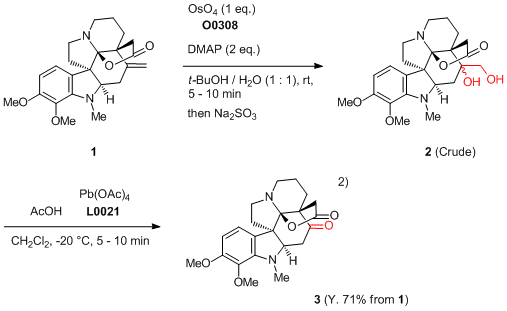
Oxidation of 1,2-Diols (Criegee Oxidation)1)
Typical Procedure:
To a solution of olefine 1 (11.9 mg, 0.030 mmol) and DMAP (7.33 mg, 0.060 mmol, 2 eq.) in t-BuOH (100 µL) is added a solution of OsO4 (7.62 mg, 0.030 mmol, 1 eq.) in water (200 µL). The orange-red solution is stirred at rt for 5-10 min. Solid Na2SO3 (19 mg, 0.15 mmol, 5 eq.) is added. The resulting mixture is applied directly to preparative TLC (CHCl3 : MeOH : NH4OH = 25 : 10 : 1) and diol is collected by washing silica gel with a mixture of CHCl3 : MeOH = 2 : 1. Concentration under reduced pressure (< 25 ℃) affords the slightly unstable diol 2, which is dissolved in CH2Cl2 (2 mL). The solution then is cooled to -20 ℃ and AcOH (9.0 mg, 8.6 µL, 5 eq.) is added, followed by solid Pb(OAc)4 (11 mg, 0.025 mmol) in portions. TLC (CH2Cl2 : MeOH = 1 : 1 and 25 : 1) monitors the end of the reaction. The resulting yellow solution is stirred at -20 ℃ for 5-10 min, washed with water, saturated NaHCO3 and brine, dried over Na2SO4 and evaporated under reduced pressure to give 3 (8.5 mg, Y. 71%) of silica gel labile ketone as a yellow powder.
To a solution of olefine 1 (11.9 mg, 0.030 mmol) and DMAP (7.33 mg, 0.060 mmol, 2 eq.) in t-BuOH (100 µL) is added a solution of OsO4 (7.62 mg, 0.030 mmol, 1 eq.) in water (200 µL). The orange-red solution is stirred at rt for 5-10 min. Solid Na2SO3 (19 mg, 0.15 mmol, 5 eq.) is added. The resulting mixture is applied directly to preparative TLC (CHCl3 : MeOH : NH4OH = 25 : 10 : 1) and diol is collected by washing silica gel with a mixture of CHCl3 : MeOH = 2 : 1. Concentration under reduced pressure (< 25 ℃) affords the slightly unstable diol 2, which is dissolved in CH2Cl2 (2 mL). The solution then is cooled to -20 ℃ and AcOH (9.0 mg, 8.6 µL, 5 eq.) is added, followed by solid Pb(OAc)4 (11 mg, 0.025 mmol) in portions. TLC (CH2Cl2 : MeOH = 1 : 1 and 25 : 1) monitors the end of the reaction. The resulting yellow solution is stirred at -20 ℃ for 5-10 min, washed with water, saturated NaHCO3 and brine, dried over Na2SO4 and evaporated under reduced pressure to give 3 (8.5 mg, Y. 71%) of silica gel labile ketone as a yellow powder.
References
- 1)Eine oxydative spaltung von glykolen (II. Mitteil. über oxydationen mit blei(IV)-salzen)
- 2)Enantioselective total synthesis of aspidophytine

PubMed Literature
Product Articles
Product Documents (Note: Some products will not have analytical charts available.)
Enter TCI Product Number
Enter KISHIDA Product Number
4-5 alphanumeric characters before the hyphen
7 alphanumeric characters
Safety Data Sheet (SDS)
Please select Language.
The requested SDS is not available.
Please Contact Us for more information.
• The requested SDS is not available.
Specifications
The requested specifications are not available.
Please Contact Us for more information.
The requested specifications are not available.
C of A & Other Certificates
Please enter Lot Number
Incorrect Lot Number. Please input only the 4-5 alphanumeric characters before the hyphen.
Incorrect Lot Number. Please input only the 7 alphanumeric characters.
• Please check that the lot number you have entered is correct. It is 4-5 alphanumeric characters before the hyphen. In particular, please check O (letter) or 0 (number) and I (letter) or 1 (number).
• If your information is correct and you are still not able to view the requested certificates, Please Contact Us for more information.
• Please check that the lot number you have entered is correct. It is 7 alphanumeric characters. In particular, please check O (letter) or 0 (number) and I (letter) or 1 (number).
Sample C of A
This is a sample C of A and may not represent a recently manufactured lot of the product.
A sample C of A for this product is not available at this time.
Analytical Charts
Please enter Lot Number
Incorrect Lot Number. Please input only the 4-5 alphanumeric characters before the hyphen.
Incorrect Lot Number. Please input only the 7 alphanumeric characters.
The requested analytical chart is not available. Sorry for the inconvenience.