


Published TCIMAIL newest issue No.201
Maximum quantity allowed is 999
Please select the quantity
CAS RN: 90357-06-5 | Product Number: B3206
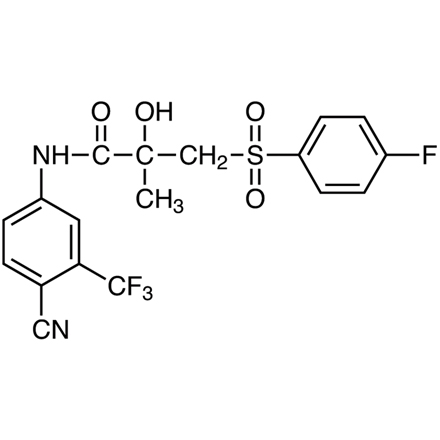
Bicalutamide

×

Purity: >98.0%(HPLC)(N)
Synonyms:
- N-[4-Cyano-3-(trifluoromethyl)phenyl]-3-[(4-fluorophenyl)sulfonyl]-2-hydroxy-2-methylpropionamide
Product Documents:
| Size | Unit Price | Belgium | Japan* | Quantity |
Shipping Information

|
|---|---|---|---|---|---|
| 200MG |
€37.00
|
1 | 27 |
|
|
| 1G |
€143.00
|
1 | 16 |
|
* Stock available in Belgium: Shipment on the same day
* Stock available in Japan: Please check the Shipping Simulation for estimated shipments. (excludes regulated items and dry ice shipments)


| Product Number | B3206 |
Purity / Analysis Method 
|
>98.0%(HPLC)(N) |
| Molecular Formula / Molecular Weight | C__1__8H__1__4F__4N__2O__4S = 430.37 |
| Physical State (20 deg.C) | Solid |
| Storage Temperature
|
Room Temperature (Recommended in a cool and dark place, <15°C) |
| Packaging and Container
|
1G-Glass Bottle with Plastic Insert (View image), 200MG-Glass Bottle with Plastic Insert (View image) |
| CAS RN | 90357-06-5 |
| Reaxys Registry Number | 5364666 |
| PubChem Substance ID | 172088993 |
| Merck Index (14) | 1200 |
| MDL Number | MFCD00869971 |
Specifications
| Appearance | White to Almost white powder to crystal |
| Purity(HPLC) | min. 98.0 area% |
| Purity(with Total Nitrogen) | min. 98.0 % |
| Melting point | 194.0 to 198.0 °C |
Properties (reference)
| Melting Point | 196 °C |
| Maximum Absorption Wavelength | 270 nm (CH__3CN) |
GHS
| Pictogram |


|
| Signal Word | Danger |
| Hazard Statements | H315 : Causes skin irritation. H319 : Causes serious eye irritation. H360 : May damage fertility or the unborn child. |
| Precautionary Statements | P501 : Dispose of contents/ container to an approved waste disposal plant. P201 : Obtain special instructions before use. P264 : Wash skin thoroughly after handling. P280 : Wear protective gloves/ protective clothing/ eye protection/ face protection/ hearing protection. P308 + P313 : IF exposed or concerned: Get medical advice/ attention. P337 + P313 : If eye irritation persists: Get medical advice/ attention. |
Related Laws:
| RTECS# | TX1413500 |
Transport Information:
| HS Number | 2930909599 |
Application
Bicalutamide: A Non-Steroidal Androgen Receptor Antagonist
Bicalutamide (ICI 176334) and flutamide [F0663] are non-steroidal androgen receptor antagonists with antiandrogenic activity. Testosterone [T0027], the most important androgen, converted to 5α-dihydrotestosterone (DHT) [A0462] by 5α-reductase type 2 which reduces the 4,5-double bond of testosterone in prostate cells. DHT has two or three times greater androgen receptor (AR) affinity than testosterone. Upon DHT binding, the AR undergoes a conformational change and releases heat shock proteins (HSPs), resulting in mRNA expression and prostate cell proliferation. Bicalutamide acts as a potent and highly selective competitive antagonist of the AR, blocks the conversion of testosterone to DHT, and inhibits the proliferation of prostate cells. Bicalutamide and flutamide are used for the treatment of prostate cancer and other androgen-dependent conditions. For your reference, [C3607] is a synthetic intermediate of bicalutamide. (The product is for research purpose only.)
References
- ICI 176,334: a novel non-steroidal, peripherally selective antiandrogen
- Novel Mutations of Androgen Receptor: A Possible Mechanism of Bicalutamide Withdrawal Syndrome
- Switch from antagonist to agonist of the androgen receptor blocker bicalutamide is associated with prostate tumour progression in a new model system
- The androgen receptor in LNCaP cells contains a mutation in the ligand binding domain which affects steroid binding characteristics and response to antiandrogens
- Bicalutamide functions as an androgen receptor antagonist by assembly of a transcriptionally inactive receptor
- Isolation and characterization of process related impurities and degradation products of bicalutamide and development of RP-HPLC method for impurity profile study

PubMed Literature
Documents
Product Articles
Product Documents (Note: Some products will not have analytical charts available.)
Enter TCI Product Number
Enter KISHIDA Product Number
4-5 alphanumeric characters before the hyphen
7 alphanumeric characters
Safety Data Sheet (SDS)
Please select Language.
The requested SDS is not available.
Please Contact Us for more information.
• The requested SDS is not available.
Specifications
The requested specifications are not available.
Please Contact Us for more information.
The requested specifications are not available.
C of A & Other Certificates
Please enter Lot Number
Incorrect Lot Number. Please input only the 4-5 alphanumeric characters before the hyphen.
Incorrect Lot Number. Please input only the 7 alphanumeric characters.
• Please check that the lot number you have entered is correct. It is 4-5 alphanumeric characters before the hyphen. In particular, please check O (letter) or 0 (number) and I (letter) or 1 (number).
• If your information is correct and you are still not able to view the requested certificates, Please Contact Us for more information.
• Please check that the lot number you have entered is correct. It is 7 alphanumeric characters. In particular, please check O (letter) or 0 (number) and I (letter) or 1 (number).
Sample C of A
This is a sample C of A and may not represent a recently manufactured lot of the product.
A sample C of A for this product is not available at this time.
Analytical Charts
Please enter Lot Number
Incorrect Lot Number. Please input only the 4-5 alphanumeric characters before the hyphen.
Incorrect Lot Number. Please input only the 7 alphanumeric characters.
The requested analytical chart is not available. Sorry for the inconvenience.