
Published TCIMAIL newest issue No.200 | Product Document Searching Made Easy by 2D Code! | TCI Life Science News December 2025 | [TCIPracticalExample] Suzuki-Miyaura Coupling Using Encapsulated... | Various analytical charts can be searched on each product detail page and Product Document Search (The kinds of analytical charts differ by product)
Maximum quantity allowed is 999
Please select the quantity
CAS RN: 73183-34-3 | 제품번호: B1964
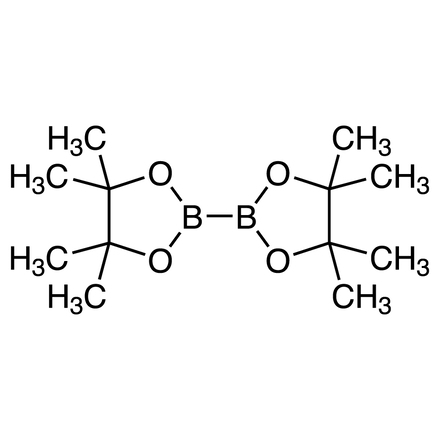
Bis(pinacolato)diboron



×

순도/분석 방법: >99.0%(GC)
동의어의:
- 4,4,4',4',5,5,5',5'-Octamethyl-2,2'-bi-1,3,2-dioxaborolane
제품문서:

•본 제품의 재고는 일본 본사의 재고입니다. 주문시, 5일안에 실험실까지 도착됩니다.
•본건의 원가격은 한국 대리점의 예상 판매가격입니다.자세한 정보가 필요하시면 연락해 주십시오.( SEJIN CI Co., Ltd. (한국총대리점) 전화 : 02-2655-2480 이메일 : sales@sejinci.co.kr)
•보관 조건은 예고없이 변경 될 수 있습니다. 제품 보관 조건의 최신 자료는 홈페이지에 기재되어 있으니 양해 부탁드립니다.
•본건의 원가격은 한국 대리점의 예상 판매가격입니다.자세한 정보가 필요하시면 연락해 주십시오.( SEJIN CI Co., Ltd. (한국총대리점) 전화 : 02-2655-2480 이메일 : sales@sejinci.co.kr)
•보관 조건은 예고없이 변경 될 수 있습니다. 제품 보관 조건의 최신 자료는 홈페이지에 기재되어 있으니 양해 부탁드립니다.


| 제품번호 | B1964 |
Purity/Analysis Method 
|
>99.0%(GC) |
| M.F. / M.W. | C__1__2H__2__4B__2O__4 = 253.94 |
| 물리적 상태 (20 ℃) | Solid |
| 보관 조건
|
Refrigerated (0-10°C) |
| 불활성 가스 하에서 보관 | Store under inert gas |
| 피해야 할 조건 | Moisture Sensitive,Heat Sensitive |
| CAS RN | 73183-34-3 |
| Reaxys-RN | 7703552 |
| PubChem Substance ID | 87564847 |
| Merck Index (14) | 1300 |
| MDL 번호 | MFCD00799570 |
규격표
| Appearance | White to Almost white powder to crystal |
| Purity(GC) | min. 99.0 % |
| Melting point | 135.0 to 142.0 °C |
| Solubility in Methanol | almost transparency |
물성치(참고치)
| mp | 138 °C |
| 용해성 (용해) | Benzene, Methanol, Ethanol |
GHS
| 픽토그램 |

|
| 신호 워드 | Warning |
| 위험물 및 유해 등록 | H302 + H312 + H332 : Harmful if swallowed, in contact with skin or if inhaled. H315 : Causes skin irritation. H319 : Causes serious eye irritation. |
| 주의 사항 | P501 : Dispose of contents/ container to an approved waste disposal plant. P261 : Avoid breathing dust/ fume/ gas/ mist/ vapors/ spray. P270 : Do not eat, drink or smoke when using this product. P271 : Use only outdoors or in a well-ventilated area. P264 : Wash skin thoroughly after handling. P280 : Wear protective gloves/ protective clothing/ eye protection/ face protection. P337 + P313 : If eye irritation persists: Get medical advice/ attention. P305 + P351 + P338 : IF IN EYES: Rinse cautiously with water for several minutes. Remove contact lenses, if present and easy to do. Continue rinsing. P362 + P364 : Take off contaminated clothing and wash it before reuse. P332 + P313 : If skin irritation occurs: Get medical advice/ attention. P301 + P312 + P330 : IF SWALLOWED: Call a POISON CENTER/doctor if you feel unwell. Rinse mouth. P302 + P352 + P312 : IF ON SKIN: Wash with plenty of water.Call a POISON CENTER/doctor if you feel unwell. P304 + P340 + P312 : IF INHALED: Remove person to fresh air and keep comfortable for breathing. Call a POISON CENTER/doctor if you feel unwell. |
법규 정보
운송 정보
| HS 번호* | 2920.90-000 |
Application
TCI Practical Example: Diborylation of Alkynes with a Platinum Catalyst

Used Chemicals
Procedure
To a degassed solution of diphenylacetylene (100 mg, 0.561 mmol) and bis(pinacolato)diboron (144 mg, 0.567 mmol) in DMF (0.5 mL) and toluene (0.5 mL) was added Pt(PPh3)4 (2 mg, 0.25 mol%). The reaction mixture was heated to 80 °C for 24 hours. After this time, the reaction was diluted with toluene (10 mL) and washed with saturated aqueous NH4Cl (2 x 10 mL). The organic phase was dried over MgSO4 and concentrated under reduced pressure. Recrystallization from MeOH afforded 1 as a white solid (241 mg, 0.558 mmol, 99%).
Experimenter’s Comments
The reaction mixture was monitored by TLC (CH2Cl2:hexane = 2:1, Rf = 0.45).
Analytical Data(Compound 1)
1H NMR (400 MHz, CDCl3); δ 7.02-7.09 (m, 6H), 6.94-6.96 (m, 4H), 1.32 (s, 24H).
13C NMR (101 MHz, CDCl3); δ 141.3, 129.3, 127.4, 125.8, 84.1, 24.9.
Lead Reference
- Platinum(0)-catalyzed diboration of alkynes

Other References
- Divergent and Stereoselective Synthesis of Tetraarylethylenes from Vinylboronates
Application
TCI Practical Example: Miyaura-Ishiyama Borylation using Pd(OAc)2

Used Chemicals
Procedure
To the solution of 3-iodobenzalehyde (1.16 g, 5.00 mmol) in dry DMF (15.0 mL) were added potassium acetate (981 mg, 10.0 mmol), palladium(II) acetate (112 mg, 0.500 mmol, 10 mol%) and bis(pinacolato)diborane (1.27 g, 5.00 mmol). The reaction mixture was stirred at 80 ºC for 7 h. The reaction mixture was cooled to room temperature and quenched with H2O (15 mL) and saturated NH4Cl aq. (10 mL), then the mixture was extracted twice with hexane : EtOAc = 4 : 1. The combined organic layer was washed with H2O (50 mL) and brine (50 mL), dried over Na2SO4, and concentrated under reduced pressure to afford the crude product as a yellow oil. The crude product was purified by column chromatography on silica-gel (hexane → hexane : EtOAc = 1:1) to afford 3-formylphenylboronic acid pinacol ester as a yellow oil (500 mg, 2.15 mmol, 43%).
Experimenter's Comments
(1) DMF was dried over molecular sieves.
(2) Completion of the reaction was confirmed by TLC (hexane : EtOAc = 1 : 1, Rf = 0.30) and GC.
Analytical Data(3-Formylphenylboronic Acid Pinacol Ester)
1H NMR (400 MHz, CDCl3); δ 10.1 (s, 1H), 8.30 (s, 1H), 8.06 (d, J = 4.0 Hz, 1H), 7.99 (ddd, J = 1.6, 1.8, 7.8 Hz, 1H), 7.53 (t, J = 8.0 Hz, 1H), 1.37 (s, 12H).
Lead Reference
- The bulky side chain of antillatoxin is important for potent toxicity: rational design of photoresponsive cytotoxins based on SAR studies
Application
Ni/Cu-Catalyzed Defluoroborylation of Fluoroarenes

Typical procedure (R = 4-Ph):
To a solution of 4-fluorobiphenyl (34.0 mg, 0.2 mmol, 1 eq.), bis(pinacolato)diboron (102 mg, 0.402 mmol, 2.0 eq.), copper iodide (7.6 mg, 0.04 mmol, 0.20 eq.), and cesium fluoride (91.0 mg, 0.6 mmol, 3.0 eq.) in toluene (0.5 mL) is added a solution of bis(1,5-cyclooctadiene)nickel(0) (5.1 mg, 0.02 mmol, 0.10 eq.) and tricyclohexylphosphine (28 mg, 99.8 µmol, 0.50 eq.) in toluene (0.5 mL) at room temperature. After stirring for 1 min at the same temperature, the mixture is heated at 80 °C with stirring for 20 h. After cooling to room temperature, saturated aqueous ammonium chloride (ca. 3 mL) is added to the mixture followed by extraction with EtOAc (ca. 3 mL × 3). The combined organic extract is dried over Na2SO4, and the filtrate is concentrated under reduced pressure. The residue is purified by preparative TLC (solvent: benzene/acetic acid = 20/1) to give 4-(4,4,5,5-tetramethyl-1,3,2-dioxaborolan-2-yl)biphenyl (55.6 mg, 0.198 mmol, 99% yield) as a colorless solid.
To a solution of 4-fluorobiphenyl (34.0 mg, 0.2 mmol, 1 eq.), bis(pinacolato)diboron (102 mg, 0.402 mmol, 2.0 eq.), copper iodide (7.6 mg, 0.04 mmol, 0.20 eq.), and cesium fluoride (91.0 mg, 0.6 mmol, 3.0 eq.) in toluene (0.5 mL) is added a solution of bis(1,5-cyclooctadiene)nickel(0) (5.1 mg, 0.02 mmol, 0.10 eq.) and tricyclohexylphosphine (28 mg, 99.8 µmol, 0.50 eq.) in toluene (0.5 mL) at room temperature. After stirring for 1 min at the same temperature, the mixture is heated at 80 °C with stirring for 20 h. After cooling to room temperature, saturated aqueous ammonium chloride (ca. 3 mL) is added to the mixture followed by extraction with EtOAc (ca. 3 mL × 3). The combined organic extract is dried over Na2SO4, and the filtrate is concentrated under reduced pressure. The residue is purified by preparative TLC (solvent: benzene/acetic acid = 20/1) to give 4-(4,4,5,5-tetramethyl-1,3,2-dioxaborolan-2-yl)biphenyl (55.6 mg, 0.198 mmol, 99% yield) as a colorless solid.
References

Application
C-H Borylation of Arenes

Typical Procedure:
A 25 mL-flask assembled a magnetic stirring bar, a septum inlet, and a condenser is charged with chloro(1,5-cyclooctadiene)iridium(I) dimer (10.1 mg, 0.015 mmol), 2,2’-bipyridyl (4.7 mg, 0.03 mmol), and bis-(pinacolato)diboron (254.0 mg, 1.0 mmol) and then flushed with nitrogen. An arene (60 mmol) is added, and the mixture is stirred at 80 °C for 16 h. The reaction mixture is analyzed by GC and GC mass spectroscopy. The product is extracted with benzene, washed with brine, and dried over MgSO4. Kugelrohr distillation gives analytically pure samples.
A 25 mL-flask assembled a magnetic stirring bar, a septum inlet, and a condenser is charged with chloro(1,5-cyclooctadiene)iridium(I) dimer (10.1 mg, 0.015 mmol), 2,2’-bipyridyl (4.7 mg, 0.03 mmol), and bis-(pinacolato)diboron (254.0 mg, 1.0 mmol) and then flushed with nitrogen. An arene (60 mmol) is added, and the mixture is stirred at 80 °C for 16 h. The reaction mixture is analyzed by GC and GC mass spectroscopy. The product is extracted with benzene, washed with brine, and dried over MgSO4. Kugelrohr distillation gives analytically pure samples.
References
- Mild iridium-catalyzed borylation of arenes. High turnover numbers, room temperature reactions, and isolation of a potential intermediate
Application
Diastereoselective Synthesis of Homoallyic Alcohols by Diboron-Promoted Coupling of Dienes and Aldehydes

References
- Diastereoselective Construction of Functionalized Homoallylic Alcohols by Ni-Catalyzed Diboron-Promoted Coupling of Dienes and Aldehydes
PubMed Literature
제품기사
[TCIMAIL No.101] for Suzuki Cross-Coupling Reaction[Research Articles] Ni/Cu-Catalyzed Defluoroborylation of Fluoroarenes
제품문서 (분석 차트를 제공하지 못할 수도 있으니 양해 바랍니다.)
SDS
언어를 선택하십시오.
요청한 SDS를 사용할 수 없습니다.
번거롭게 해드려 죄송하지만 이 양식 보다 문의 해주십시오.
규격표
시험성적서, 각종 증명서
롯트 번호를 입력하십시오.
잘못된 로트 번호가 입력되었습니다.
샘플 시험성적서
시험성적서 샘플을 다운로드할 수 있습니다. 샘플은 반드시 최신 로트의 결과를 나타내는 것은 아닙니다.
본 제품의 샘플시험성적서는 현재 준비되어 있지 않습니다.
분석 차트
롯트 번호를 입력하십시오.
잘못된 로트 번호가 입력되었습니다.
죄송합니다만 찾으시는 분석차트는 없습니다.