


Published TCIMAIL newest issue No.200
Maximum quantity allowed is 999
Bitte wählen Sie die Menge aus.
CAS RN: 58-08-2 | Produkte #: C2042
Caffeine

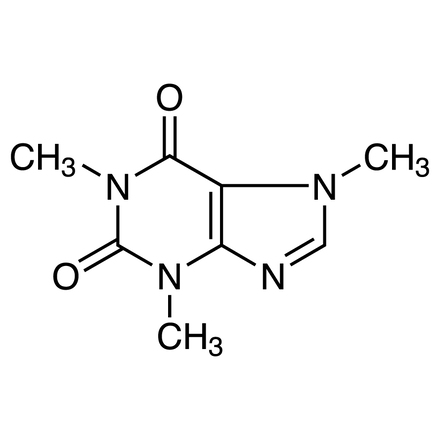
×

Reinheit: >98.0%(T)(HPLC)
Synonyme
- 1,3,7-Trimethylxanthine
Produktdokumente:
| Einheit | Stückpreis | Belgien | Japan* | Menge |
Versandinformationen

|
|---|---|---|---|---|---|
| 25G |
€17.00
|
15 | ≥100 |
|
|
| 500G |
€77.00
|
2 | ≥40 |
|
*Lagerbestand in Belgien: Versand am selben Tag
*Lagerbestand in Japan: Bitte prüfen Sie die Versandsimulation für voraussichtliche Lieferzeiten. (ausgenommen regulierte Produkte und Trockeneissendungen)


| Artikel # | C2042 |
Reinheit / Analysenmethode 
|
>98.0%(T)(HPLC) |
| Summenformel / Molekülmasse | C__8H__1__0N__4O__2 = 194.19 |
| Physikalischer Zustand (20 °C) | Solid |
| Lagerungstemperatur
|
Room Temperature (Recommended in a cool and dark place, <15°C) |
| CAS RN | 58-08-2 |
| Reaxys Registrierungsnummer | 17705 |
| PubChem-Stoff-ID | 87558398 |
| Merck-Index (14) | 1636 |
Spezifikation
| Appearance | White to Almost white powder to crystaline |
| Purity(HPLC) | min. 98.0 area% |
| Purity(Nonaqueous Titration) | min. 98.0 % |
| Solubility in hot Methanol | almost transparency |
| NMR | confirm to structure |
Eigenschaften
| Schmelzpunkt | 238 °C |
| Löslichkeit in Wasser | Slightly soluble |
| Löslichkeitsgrad in Wasser | 21.7 g/l |
| Löslichkeit (löslich in) | Chloroform |
| Löslichkeit (wenig löslich in) | Alcohol, Benzene, Acetone |
GHS
| Piktogramm |


|
| Signalwort | Gefahr |
| Gefahrenhinweise | H301 : Giftig bei Verschlucken. H332 : Gesundheitsschädlich bei Einatmen. H360 : Kann die Fruchtbarkeit beeinträchtigen oder das Kind im Mutterleib schädigen. H412 : Schädlich für Wasserorganismen, mit langfristiger Wirkung. |
| Sicherheitshinweise | P261 : Einatmen von Staub vermeiden. P201 : Vor Gebrauch besondere Anweisungen einholen. P264 : Nach Gebrauch Haut gründlich waschen. P280 : Schutzhandschuhe/ Schutzkleidung/ Augenschutz/ Gesichtsschutz/ Gehörschutz Tragen. P308 + P313 : BEI Exposition oder falls betroffen: Ärztlichen Rat einholen/ ärztliche Hilfe hinzuziehen. P301 + P310 + P330 : BEI VERSCHLUCKEN: Sofort GIFTINFORMATIONSZENTRUM/Arzt anrufen. Mund ausspülen. |
Verwandte Gesetze:
| EC-Nummern | 200-362-1 |
| RTECS # | EV6475000 |
Transportinformationen:
| UN-Nummer | UN1544 |
| Klasse | 6.1 |
| Verpackungsgruppe (DOT-AIR) | III |
| HS-Nr. (Import / Export) (TCI-E) | 2939300000 |
Anwendung
Efflux pump research
Caffeine is one of the methylxanthine compounds having activity as an efflux pump inhibitor in Staphylococcus aureus.1) Although having no antimicrobial effect itself, caffeine has been reported to show synergistic effects on antibiotics, carbenicillin (C2241), ceftizoxime (C2622), and gentamicin (G0383) in Pseudomonas aeruginosa and Staphylococcus aureus.2-4)
(The product is for research purpose only.)
(The product is for research purpose only.)
References
- 1) The inhibitory effect of fluphenazine decanoate and caffeine on Staphylococcus aureus efflux pumps
- 2) In vitro Evaluation of Methylxanthines and Some Antibiotics: Interaction against Staphylococcus aureus and Pseudomonas aeruginosa
- 3) Interaction of methylxanthines and gentamicin against Staphylococcus aureus and Pseudomonas aeruginosa: Role of phosphodiesterase inhibition
- 4) Effects of Omeprazole and Caffeine Alone and in Combination with Gentamicin and Ciprofloxacin Against Antibiotic Resistant Staphylococcus Aureus and Escherichia Coli Strains
- 1) Actions of caffeine in the brain with special reference to factors that contribute to its widespread use (a review)
- 2) Caffeine and adenosine (a review)
- 3) Regulation of the G2/M transition by p53 (a review)
- 4) The enigmatic effects of caffeine in cell cycle and cancer (a review)

Anwendung
Caffeine: A Non-Selective Adenosine Receptor Antagonist, and an Inhibitor Cell Cycle of Progression
Caffeine is widely contained in foods and beverages and is the most widely consumed central-nervous-system stimulant.1) It has been known that adenosine is a modulator that has a pervasive and generally inhibitory effect on neuronal activity. Caffeine, a mimic of adenosine, has the opposite effect of adenosine, and causes most of its biological effects via antagonizing all types of adenosine receptors (ARs), such as A1, A2A, A3, and A2B.2) Besides, it has been reported that caffeine is capable of abrogating cell cycle checkpoints in several different mammalian cell types.3,4) Caffeine has been used to help delineate the role of p53 (cellular tumor antigen p53 gene) in the G2 arrest that occurs in response to DNA damage.3) (The product is for research purpose only.)
References
PubMed Literatur
Dokumente
Produktartikel
Produktdokumente (Hinweis: Für einige Produkte sind keine Analysediagramme verfügbar.)
Sicherheitsdatenblatt (SDB)
Bitte wählen Sie Sprache.
Das angeforderte SDB ist nicht verfügbar.
Bitte Kontaktieren Sie uns für mehr Informationen.
Spezifikationsdokumenten
AZ & andere Zertifikate
Bitte geben Sie die Lotnummer ein
Falsche Chargennummer wurde eingegeben. Bitte geben Sie nur 4-5 alphanumerische Zeichen vor dem Bindestrich ein.
Muster-AZ
Dies ist ein Muster-AZ und repräsentiert möglicherweise nicht eine kürzlich hergestellte Charge des Produkts.
Ein Muster-AZ für dieses Produkt ist zur Zeit nicht verfügbar.
Analytische Diagramme
Bitte geben Sie die Lotnummer ein
Falsche Chargennummer wurde eingegeben. Bitte geben Sie nur 4-5 alphanumerische Zeichen vor dem Bindestrich ein.
Das angeforderte Analysediagramm ist nicht verfügbar. Wir entschuldigen uns für die Unannehmlichkeiten.