


Published TCIMAIL newest issue No.201
Maximum quantity allowed is 999
Gelieve het aantal te selecteren
CAS RN: 90357-06-5 | Producten #: B3206
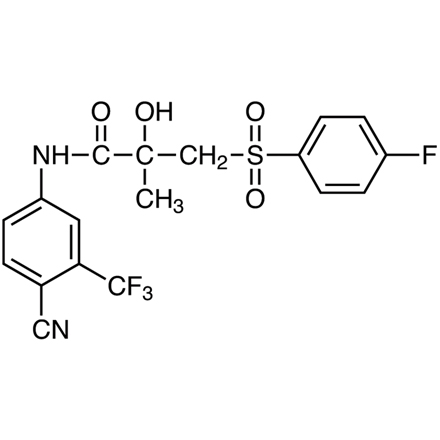
Bicalutamide

×

Zuiverheid: >98.0%(HPLC)(N)
Synoniemen
- N-[4-Cyano-3-(trifluoromethyl)phenyl]-3-[(4-fluorophenyl)sulfonyl]-2-hydroxy-2-methylpropionamide
Productdocumenten:
| Afmeting | Eenheidsprijs | België | Japan* | Hoeveelheid |
Verzendinformatie

|
|---|---|---|---|---|---|
| 200MG |
37,00 €
|
1 | 27 |
|
|
| 1G |
143,00 €
|
1 | 16 |
|
*Voorraad beschikbaar in België: Verzending dezelfde dag
*Voorraad beschikbaar in Japan: Raadpleeg de verzendsimulatie voor geschatte levertijden. (met uitzondering van gereguleerde producten en zendingen met droogijs)


| Artikel # | B3206 |
Zuiverheid / Analysemethode 
|
>98.0%(HPLC)(N) |
| Moleculaire formule / molecuulgewicht | C__1__8H__1__4F__4N__2O__4S = 430.37 |
| Fysieke toestand (20 graden C) | Solid |
| Opslag condities
|
Room Temperature (Recommended in a cool and dark place, <15°C) |
| Verpakking
|
1G-Glass Bottle with Plastic Insert (Bekijk afbeelding), 200MG-Glass Bottle with Plastic Insert (Bekijk afbeelding) |
| CAS RN | 90357-06-5 |
| Reaxys registratienummer | 5364666 |
| PubChem product ID | 172088993 |
| Merck-index (14) | 1200 |
| MDL-nummer | MFCD00869971 |
Specificatie
| Appearance | White to Almost white powder to crystal |
| Purity(HPLC) | min. 98.0 area% |
| Purity(with Total Nitrogen) | min. 98.0 % |
| Melting point | 194.0 to 198.0 °C |
eigenschappen
| Smeltpunt | 196 °C |
| Maximale golflengte | 270 nm (CH__3CN) |
GHS
| Pictogram |


|
| Signaalwoord | Gevaar |
| Gevarenaanduidingen | H315 : Veroorzaakt huidirritatie. H319 : Veroorzaakt ernstige oogirritatie. H360 : Kan de vruchtbaarheid of het ongeboren kind schaden. |
| Voorzorgsmaatregelen | P501 : Inhoud/ verpakking afvoeren naar een erkend afvalverwerkingsbedrijf. P201 : Alvorens te gebruiken de speciale aanwijzingen raadplegen. P264 : Na het werken met dit product de huid grondig wassen. P280 : Draag veiligheidshandschoenen/beschermende kleding/ veiligheidsbril/ gezichtsbescherming/ gehoorbeschermers. P308 + P313 : NA (mogelijke) blootstelling: een arts raadplegen. P337 + P313 : Bij aanhoudende oogirritatie: een arts raadplegen. |
Gerelateerde wetten:
| RTECS # | TX1413500 |
Transport informatie:
| HS-NR (invoer / uitvoer) (TCI-E) | 2930909599 |
Toepassing
Bicalutamide: A Non-Steroidal Androgen Receptor Antagonist
Bicalutamide (ICI 176334) and flutamide [F0663] are non-steroidal androgen receptor antagonists with antiandrogenic activity. Testosterone [T0027], the most important androgen, converted to 5α-dihydrotestosterone (DHT) [A0462] by 5α-reductase type 2 which reduces the 4,5-double bond of testosterone in prostate cells. DHT has two or three times greater androgen receptor (AR) affinity than testosterone. Upon DHT binding, the AR undergoes a conformational change and releases heat shock proteins (HSPs), resulting in mRNA expression and prostate cell proliferation. Bicalutamide acts as a potent and highly selective competitive antagonist of the AR, blocks the conversion of testosterone to DHT, and inhibits the proliferation of prostate cells. Bicalutamide and flutamide are used for the treatment of prostate cancer and other androgen-dependent conditions. For your reference, [C3607] is a synthetic intermediate of bicalutamide. (The product is for research purpose only.)
References
- ICI 176,334: a novel non-steroidal, peripherally selective antiandrogen
- Novel Mutations of Androgen Receptor: A Possible Mechanism of Bicalutamide Withdrawal Syndrome
- Switch from antagonist to agonist of the androgen receptor blocker bicalutamide is associated with prostate tumour progression in a new model system
- The androgen receptor in LNCaP cells contains a mutation in the ligand binding domain which affects steroid binding characteristics and response to antiandrogens
- Bicalutamide functions as an androgen receptor antagonist by assembly of a transcriptionally inactive receptor
- Isolation and characterization of process related impurities and degradation products of bicalutamide and development of RP-HPLC method for impurity profile study

PubMed Literatuur
Documenten
Productartikelen
Productdocumenten (Opmerking: Voor sommige producten zijn geen analytische grafieken beschikbaar.)
Voer het productnummer id
text.certificate.product.input.placeholder.kishida
4-5 alfanumerieke tekens vóór koppelteken
text.certificate.lotno.input.placeholder.kishida
Veiligheidsinformatie-blad (VIB)
Selecteer alstublieft taal.
Het gevraagde SDS is niet beschikbaar.
Neem contact met ons op voor meer informatie.
• text.sds.search.errormsg.content.1.kishida
Specificatiedocument
Het gevraagde specificatiedocument is niet beschikbaar.
Neem contact met ons op voor meer informatie.
text.specification.search.errormsg.content.1.kishida
Analyse certificaat & andere certificaten
Gelieve het lotnummer in te vullen aub
Er is een onjuist lotummer ingevoerd. Voer alleen 4-5 alfanumerieke tekens vóór het koppelteken in.
text.certificate.analysis.pdf.lotNumber.errorMessage.alphanumeric.kishida
• Controleer of het door u ingevoerde lotummer juist is. Het zijn 4-5 alfanumerieke tekens vóór het koppelteken. Controleer zorgvuldig of O (alfabet) of 0 (cijfer), "I (alfabet) of 1 (cijfer) in het bijzonder.
• Als uw invoer correct is en u het certificaat nog steeds niet ziet, neem dan contact met ons op.
• text.certificate.analysis.pdf.errormsg.content6.kishida
Voorbeeldanalysecertificaat
Dit is een voorbeeldanalysecertificaat en vertegenwoordigt mogelijk niet een recent geproduceerde partij van het product.
Een voorbeeldanalysecertificaat voor dit product is op dit moment niet beschikbaar.
Analytische grafieken
Gelieve het lotnummer in te vullen aub
Er is een onjuist lotummer ingevoerd. Voer alleen 4-5 alfanumerieke tekens vóór het koppelteken in.
text.certificate.analysis.pdf.lotNumber.errorMessage.alphanumeric.kishida
De gevraagde analytische grafiek is niet beschikbaar. Onze excuses voor het ongemak.