Published TCIMAIL newest issue No.201
Maximum quantity allowed is 999

| Taille | Prix unitaire | Belgique | Japon * | Quantité |
Informations d'expédition

|
|---|---|---|---|---|---|
| 25G |
€17.00
|
≥40 | ≥100 |
|
|
| 500G |
€77.00
|
4 | 36 |
|
*Stock disponible en Belgique : Expédition le jour même
*Stock disponible au Japon : Veuillez consulter la simulation d'expédition pour une estimation des délais d'expédition (hors articles réglementés et expédition avec Carboglace)
| Numéro de produit | C2042 |
Pureté / Méthode d'analyse 
|
>98.0%(T)(HPLC) |
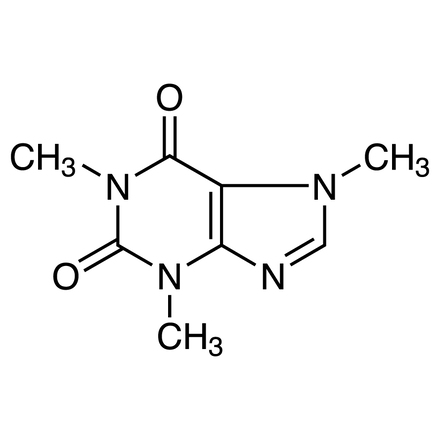
| Formule moléculaire / poids moléculaire | C__8H__1__0N__4O__2 = 194.19 |
| Etat physique (20 ° C) | Solid |
| Condition de stockage
|
Room Temperature (Recommended in a cool and dark place, <15°C) |
| CAS RN | 58-08-2 |
| Numéro de registre de Reaxys | 17705 |
| Identifiant de la substance PubChem | 87558398 |
| Indice Merck (14) | 1636 |
| Appearance | White to Almost white powder to crystaline |
| Purity(HPLC) | min. 98.0 area% |
| Purity(Nonaqueous Titration) | min. 98.0 % |
| Solubility in hot Methanol | almost transparency |
| NMR | confirm to structure |
| Point de fusion | 238 °C |
| solubilité dans l'eau | Slightly soluble |
| Degré de solubilité dans l'eau | 21.7 g/l |
| Solubilité (soluble dans) | Chloroform |
| Solubilité (légèrement sol. In) | Alcohol, Benzene, Acetone |
| Pictogramme |


|
| Mot de signal | Danger |
| Mentions de danger | H301 : Toxique en cas d'ingestion. H332 : Nocif par inhalation. H360 : Peut nuire à la fertilité ou au fœtus. H412 : Nocif pour les organismes aquatiques, entraîne des effets néfastes à long terme. |
| Conseils de prudence | P261 : Éviter de respirer les poussières. P201 : Se procurer les instructions spéciales avant utilisation. P264 : Se laver la peau soigneusement après manipulation. P280 : Porter des gants de protection/ des vêtements de protection/ un équipment de protection des yeux/ du visage/ auditive. P308 + P313 : EN CAS d'exposition prouvée ou suspectée: consulter un médecin. P301 + P310 + P330 : EN CAS D'INGESTION: Appeler immédiatement un CENTRE ANTIPOISON/un médecin. Rincer la bouche. |
| Numéros CE | 200-362-1 |
| RTECS # | EV6475000 |
| Numéro UN | UN1544 |
| Classe | 6.1 |
| Groupe d'emballage (DOT-AIR) | III |
| N ° SH (import / export) (TCI-E) | 2939300000 |
La FDS demandée n'est pas disponible.
Nous contacter pour plus d'informations.
• text.sds.search.errormsg.content.1.kishida
Les spécifications demandées ne sont pas disponibles.
Nous contacter pour plus d'informations.
text.specification.search.errormsg.content.1.kishida
• Veuillez vérifier que le numéro de lot que vous avez saisi est correct. Il s'agit de 4 à 5 caractères alphanumériques avant le trait d'union. Veuillez vérifier soigneusement si O (alphabet) ou 0 (chiffre), "I (alphabet) ou 1 (chiffre) en particulier.
• Si les informations sont correctes et que vous ne pouvez toujours pas voir le certificat demandé, veuillez nous contacter.
• text.certificate.analysis.pdf.errormsg.content6.kishida
Un échantillon CoA pour ce produit n'est pas disponible pour le moment.
Le tableau analytique demandé n'est pas disponible. Nous sommes désolés pour ce désagrément.