
Maximum quantity allowed is 999
CAS RN: 64-19-7 | Product Number: A2035
Acetic Acid
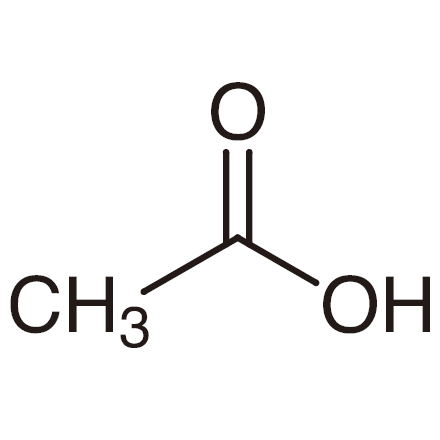


Purity: >99.5%(T)
| Size | Unit Price | Shanghai | Tianjin | Japan* |
|---|---|---|---|---|
| 300ML |
¥250.00
|
18 | Contact Us | ≥100 |
* For order or inquiry, please contact
Our Authorized Distributors.
*TCI frequently reviews storage conditions to optimize them. Please note that the latest information on the storage temperature for the products is described on our website.
* To send your quote request for bulk quantities, please click on the "Request Bulk Quote" button. Please note that we cannot offer bulk quantities for some products.


| Product Number | A2035 |
Purity / Analysis Method 
|
>99.5%(T) |
| Molecular Formula / Molecular Weight | C__2H__4O__2 = 60.05 |
| Physical State (20 deg.C) | Liquid |
| Storage Temperature
|
Room Temperature (Recommended in a cool and dark place, <15°C) |
| Store Under Inert Gas | Store under inert gas |
| Condition to Avoid | Hygroscopic |
| CAS RN | 64-19-7 |
| Reaxys Registry Number | 506007 |
| Merck Index (14) | 55 |
| MDL Number | MFCD00036152 |
| Appearance | Colorless clear liquid |
| Purity(Neutralization titration) | min. 99.5 % |
| NMR | confirm to structure |
| Melting Point | 17 °C |
| Boiling Point | 118 °C |
| Flash point | 39 °C |
| Specific Gravity (20/20) | 1.05 |
| Refractive Index | 1.37 |
| Maximum Absorption Wavelength | 205 nm (H__2O) |
| Solubility in water | Completely miscible |
| Solubility (miscible with) | Alcohol, Benzene, Ether, Acetone |
| Pictogram |


|
| Signal Word | Danger |
| Hazard Statements | H312 : Harmful in contact with skin. H303 : May be harmful if swallowed. H314 : Causes severe skin burns and eye damage. H370 : Causes damage to organs. H402 : Harmful to aquatic life. H226 : Flammable liquid and vapor. H290 : May be corrosive to metals. |
| Precautionary Statements | P501 : Dispose of contents/ container to an approved waste disposal plant. P273 : Avoid release to the environment. P260 : Do not breathe dust/ fume/ gas/ mist/ vapors/ spray. P270 : Do not eat, drink or smoke when using this product. P240 : Ground/bond container and receiving equipment. P210 : Keep away from heat/sparks/open flames/hot surfaces. No smoking. P233 : Keep container tightly closed. P234 : Keep only in original container. P243 : Take precautionary measures against static discharge. P241 : Use explosion-proof electrical/ ventilating/ lighting/ equipment. P242 : Use only non-sparking tools. P264 : Wash skin thoroughly after handling. P280 : Wear protective gloves/ protective clothing/ eye protection/ face protection. P370 + P378 : In case of fire: Use dry sand, dry chemical or alcohol-resistant foam to extinguish. P390 : Absorb spillage to prevent material damage. P308 + P311 : IF exposed or concerned: Call a POISON CENTER/doctor. P362 + P364 : Take off contaminated clothing and wash it before reuse. P303 + P361 + P353 : IF ON SKIN (or hair): Take off immediately all contaminated clothing. Rinse skin with water/shower. P301 + P330 + P331 : IF SWALLOWED: Rinse mouth. Do NOT induce vomiting. P304 + P340 + P310 : IF INHALED: Remove person to fresh air and keep comfortable for breathing. Immediately call a POISON CENTER/doctor. P305 + P351 + P338 + P310 : IF IN EYES: Rinse cautiously with water for several minutes. Remove contact lenses, if present and easy to do. Continue rinsing. Immediately call a POISON CENTER/doctor. P403 + P235 : Store in a well-ventilated place. Keep cool. P406 : Store in corrosive resistant container with a resistant inner liner. P405 : Store locked up. |
| CN Number | 2630 |
| RTECS# | AF1225000 |
| UN Number | UN2789 |
| Class | 8 / 3 |
| Packing Group | II |
| Customs Control Conditions (Q) |

References
- 1)A Simple Method for the Esterification of Carboxylic Acids Using Chlorosilanes
- 2)A Novel Method for the Preparation of Macrolides from ω-Hydroxycarboxylic Acids
- 3)An Efficient Esterification Reaction between Equimolar Amounts of Free Carboxylic Acids and Alcohols by the Combined Use of Octamethylcyclotetrasiloxane and a Catalytic Amount of Titanium(IV) Chloride Tris(trifluoromethanesulfonate)
- 4)Scandium Trifluoromethanesulfonate as an Extremely Active Lewis Acid Catalyst in Acylation of Alcohols with Acid Anhydrides and Mixed Anhydrides
- 5)Protection for the Hydroxyl Group, Including 1,2- and 1,3-Diols
- P. G. M. Wuts, in Greene’s Protective Groups in Organic Synthesis, 5th ed., ed. by P. G. M. Wuts, John Wiley & Sons, Inc., Hoboken, New Jersey, 2014, Chap. 2, 17.

References
- Suprofen, a potent antagonist of acetic acid-induced writhing in rats
- C. J. Niemegeers, J. A. Van Bruggen, P. A. Janssen, Arzneimittelforschung 1975, 25, 1505.
- Acetic acid and phenylquinone writhing test: a critical study in mice
- P. P. Singh, A. Y. Junnarkar, C. S. Rao, R. K. Varma, D. R. Shridhar, Methods Find. Exp. Clin. Pharmacol. 1983, 5, 601.
- Effects of intrathecally administered aminoglycoside antibiotics, calcium-channel blockers, nickel and calcium on acetic acid-induced writhing test in mice
- Acetic acid induced painful endogenous infliction in writhing test on mice
References
- Effects of resiniferatoxin desensitization of capsaicin-sensitive afferents on detrusor over-activity induced by intravesical capsaicin, acetic acid or ATP in conscious rats
- GRC-6211, a new oral specific TRPV1 antagonist, decreases bladder overactivity and noxious bladder input in cystitis animal models
References
- Effects of sodium hyaluronate on epithelial healing of the vesical mucosa and vesical fibrosis in rabbits with acetic acid induced cystitis
- Effects of exogenous glycosaminoglycans on the histological structure of the rat bladder in experimental cystitis
References
- An overview of acetic acid ulcer models--the history and state of the art of peptic ulcer research
References
- Experimental production of diffuse colitis in rats
- Insights from advances in research of chemically induced experimental models of human inflammatory bowel disease
- Experimental colitis in animal models
Documents
Safety Data Sheet (SDS)
The requested SDS is not available.
Please Contact Us for more information.
Specifications
C of A & Other Certificates
Sample C of A
A sample C of A for this product is not available at this time.
Analytical Charts
The requested analytical chart is not available. Sorry for the inconvenience.
Other Documents
Related Products
![Acetic Acid [for LC-MS]](/medias/A3377.jpg?context=bWFzdGVyfHJvb3R8MTU0ODR8aW1hZ2UvanBlZ3xhREJsTDJoa09DODVNRGc0TnpNMU5URXdOVFU0TDBFek16YzNMbXB3Wnd8NDE0MDk1ODM2ZGQ2Y2FlMDQ4MmNiZTljNzk2NTFiYTY2YjViODI2NjJkZjQ2NTg4NzE5MTYxYzEwZWRjZDJmOA "Acetic Acid [for LC-MS]")
Acetic Acid [for LC-MS]
| Product # | A3377 |
| CAS RN | 64-19-7 |
| Purity / Analysis Method: | >99.5%(T) |