Product Document Searching Made Easy by 2D Code! | [TCIPracticalExample] The Mitsunobu Type SN2 Reaction Using...
Users can now ask questions to the AI chatbot by clicking the chatbot icon in the bottom-right corner of the website.
Maximum quantity allowed is 999
| Size | Unit Price | Hyderabad | Japan* | Quantity |
|---|---|---|---|---|
| 1G |
₹25,600.00
|
Contact Us | ≥40 |
|
*Upon orders receipt, Hyderabad stocks will be dispatched on the same day.
*Items available in Japan warehouse will be dispatched in 10-12 working days.
*INR price is exclusive of domestic taxes applicable.
*TCI frequently reviews storage conditions to optimize them. Please note that the latest information on the storage temperature for the products is described on our website.
| Product Number | P2161 |
Purity / Analysis Method
|
>98.0%(T) |
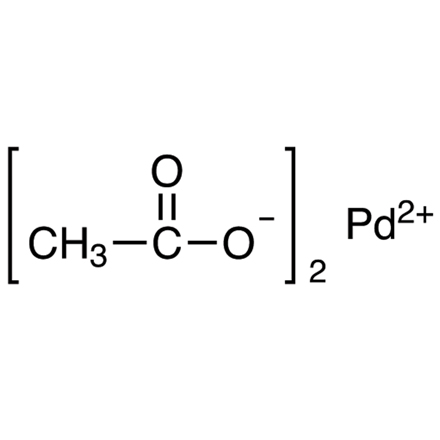
| Molecular Formula / Molecular Weight | C__4H__6O__4Pd = 224.51 |
| Physical State (20 deg.C) | Solid |
Storage Temperature
|
Room Temperature (Recommended in a cool and dark place, <15°C) |
| CAS RN | 3375-31-3 |
| Reaxys Registry Number | 3602276 |
| PubChem Substance ID | 253662088 |
| SDBS (AIST Spectral DB) | 12841 |
| Merck Index (14) | 6991 |
| MDL Number | MFCD00012453 |
| Appearance | Light yellow to Brown powder to crystal |
| Purity(Chelometric Titration) | min. 98.0 % |
| Elemental analysis(Nitrogen) | max. 0.30 % |
| Melting Point | 205 °C |
| Maximum Absorption Wavelength | 400 nm (EtOH) |
| Solubility (soluble in) | Acetone |
| Pictogram |
|
| Signal Word | Danger |
| Hazard Statements | H318 : Causes serious eye damage. H317 : May cause an allergic skin reaction. H410 : Very toxic to aquatic life with long lasting effects. |
| Precautionary Statements | P501 : Dispose of contents/ container to an approved waste disposal plant. P261 : Avoid breathing dust. P273 : Avoid release to the environment. P272 : Contaminated work clothing should not be allowed out of the workplace. P280 : Wear protective gloves/ eye protection/ face protection. P302 + P352 : IF ON SKIN: Wash with plenty of water. P391 : Collect spillage. P362 + P364 : Take off contaminated clothing and wash it before reuse. P333 + P313 : If skin irritation or rash occurs: Get medical advice/ attention. P305 + P351 + P338 + P310 : IF IN EYES: Rinse cautiously with water for several minutes. Remove contact lenses, if present and easy to do. Continue rinsing. Immediately call a POISON CENTER/doctor. |
| RTECS# | AJ1900000 |
| UN Number | UN3077 |
| Class | 9 |
| Packing Group | III |

To the solution of 3-iodobenzalehyde (1.16 g, 5.00 mmol) in dry DMF (15.0 mL) were added potassium acetate (981 mg, 10.0 mmol), palladium(II) acetate (112 mg, 0.500 mmol, 10 mol%) and bis(pinacolato)diborane (1.27 g, 5.00 mmol). The reaction mixture was stirred at 80 ºC for 7 h. The reaction mixture was cooled to room temperature and quenched with H2O (15 mL) and saturated NH4Cl aq. (10 mL), then the mixture was extracted twice with hexane : EtOAc = 4 : 1. The combined organic layer was washed with H2O (50 mL) and brine (50 mL), dried over Na2SO4, and concentrated under reduced pressure to afford the crude product as a yellow oil. The crude product was purified by column chromatography on silica-gel (hexane → hexane : EtOAc = 1:1) to afford 3-formylphenylboronic acid pinacol ester as a yellow oil (500 mg, 2.15 mmol, 43%).
(1) DMF was dried over molecular sieves.
(2) Completion of the reaction was confirmed by TLC (hexane : EtOAc = 1 : 1, Rf = 0.30) and GC.
1H NMR (400 MHz, CDCl3); δ 10.1 (s, 1H), 8.30 (s, 1H), 8.06 (d, J = 4.0 Hz, 1H), 7.99 (ddd, J = 1.6, 1.8, 7.8 Hz, 1H), 7.53 (t, J = 8.0 Hz, 1H), 1.37 (s, 12H).
To a solution of 4-bromophenol (1.5 g, 8.7 mmol) in triethylamine (10 mL), styrene (1.1 g, 10.8 mmol), tri(o-tolyl)phosphine (0.16 g, 0.52 mmol) and palladium(II) acetate (0.020 g, 0.087 mmol) were successively added at room temperature. The reaction mixture was stirred overnight at 100 °C under nitrogen atmosphere. To a 1 mol/L HCl aq. (100 mL) the reaction mixture was added below 15 °C. Then diethyl ether (100 mL) was added and the mixture was stirred for 10 min. The solution was partitioned and the water phase was extracted by diethyl ether (50 mL). Then combined organic layer was dried over sodium sulfate and filtered. The residue was recrystallized from toluene giving trans-4-hydroxystilbene as a pale brown solid (0.97 g, 57% yield).
The reaction mixture was monitored by 1H NMR.
1H NMR (400 MHz, CDCl3); δ 9.59 (s, 1H), 7.53 (d, J = 7.3 Hz, 2H), 7.42 (d, J = 8.2 Hz, 2H), 7.34 (dd, J = 7.8, 7.3 Hz, 2H), 7.22 (t, J = 7.3 Hz, 1H), 7.15 (d, J = 16.5 Hz, 1H), 7.01 (d, J = 16.5 Hz, 1H), 6.77 (d, J = 8.7 Hz, 2H).
13C NMR (101 MHz, CDCl3); δ 157.3, 137.6, 128.7 (2 C), 128.5, 128.1, 127.9 (2 C), 127.0, 126.1 (2 C), 125.1, 115.6 (2 C).

To a solution of sodium tert-butoxide (0.54 g, 5.6 mmol), palladium(II) acetate (4.5 mg, 0.020 mmol), and JohnPhos (0.012 g, 0.040 mmol) in toluene (8 mL) 4-chlorotoluene (0.51 g, 4.0 mmol) and morpholine (0.42 g, 4.8 mmol) were successively added at room temperature. The mixture was stirred under nitrogen atmosphere at room temperature for 1.5 days, then under reflux condition for 0.5 days. Diethyl ether (20 mL) was added to the reaction mixture and filtered through celite. Solvent was removed and the residue was purified by column chromatography (1:4 ethyl acetate / hexane on SiO2), giving 4-(p-tolyl)morpholine as a pale brown solid (0.45 g, 63% yield).
The reaction mixture was monitored by 1H NMR.
1H NMR (400 MHz, CDCl3); δ 7.10 (d, J = 8.2 Hz, 2H), 6.85 (d, J = 8.2 Hz, 2H), 3.87 (t, J = 4.6 Hz, 4H), 3.12 (t, J = 4.8 Hz, 4H), 2.28 (s, 3H).
13C NMR (101 MHz, CDCl3); δ 129.9 (4 C), 116.2 (2 C), 67.1 (2 C), 50.1 (2 C), 20.6.

To a solution of palladium(II) acetate (44.9 mg, 0.200 mmol, 4 mol%), XPhos (143 mg, 0.300 mmol, 6 mol%), cesium fluoride (2.28 g, 15.0 mmol) and 2-chlorophenothiazine (1.17 g, 5.00 mmol) in toluene (15.0 mL) was added tributyl(2-thienyl)tin (2.24 g, 1.90 mL, 6.00 mmol) and the reaction solution was stirred at 80 ºC for 24 h. After reaction mixture was cooled to room temperature, dichloromethane (15 mL) and H2O (15 mL) were added. Separated water phase was extracted with dichloromethane (15 mL) for 3 times. Combined organic layer was dried over MgSO4 (10 g) and concentrated under reduced pressure to afford the crude product as a brown solid. Crude was purified by column chromatography on silica-gel (hexane: EtOAc = 50 : 1 ~ 5 : 1 → dichloromethane) to afford 2-(thiophen-2-yl)-10H-phenothiazine as a yellow solid (990 mg, 3.51 mmol, 70%).
Completion of the reaction was confirmed by TLC (Hexane:EtOAc = 10:1, Rf: S.M.=0.28 T.M.=0.18) and GC.
1H NMR (400 MHz, CDCl3); δ 7.92 (brs, 1H), 7.42 (dd, J = 0.9, 5.0 Hz, 1H), 7.35 (dd, J = 0.9, 3.6 Hz, 1H), 7.08-7.13 (m, 2H), 6.94-7.03 (m, 4H), 6.73-6.82 (m, 2H).

The requested SDS is not available.
Please Contact Us for more information.
A sample C of A for this product is not available at this time.
The requested analytical chart is not available. Sorry for the inconvenience.